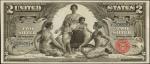





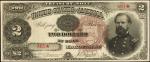

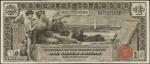



Friedberg 248 (W-368). 1896 $2 Silver Certificate. PCGS Currency Superb Gem New 67 PPQ.This well embossed and broadly margined $2 Educational is among the finest we have had the privilege of offering. It displays stunning details in the engraved design elements and is enhanced by sharply printed and boldly colored overprint inks.<p>The "Educational" $2 note offers an exceptionally beautiful design. The face features the thoughtfully executed vignette, <em>Science Presenting Steam and Electricity to Commerce and Manufacture, </em>an allegorical scene in the finest traditional style -emblematic of the waning years of Victorian art and expression, perhaps with a hint of the Art Nouveau style introduced in Europe by Alphonse Mucha and popularized by Champenois, Paris printer of postcards and posters. The vignette underwent several developmental design modifications before this final version was adopted, including a change from the originally submitted design for the $50 denomination that was never issued. This did not please the designer, Edwin Blashfield, who complained in writing to engraver G.F.C. Smillie in April 1895, "In regard to changing [the] denomination of my fifty, please tell Mr. Johnson [Claude Johnson, Director of the Bureau of Engraving and Printing, who had made the decision to change the denomination] that in addition to my other reasons given before and which are the same today as then, I also object distinctly on artistic grounds to the change from fifty to a two. You can easily see that the 50 is an important compositional factor in the building up of my design…the result of such a change would be that from a design which is my work and which I endorse as the best I was able to do at the time, it would become a design not mine compositionally and which I could not endorse."<p>In keeping with the educational theme, the back of the note features engravings of Robert Fulton and Samuel F.B. Morse, both remembered for their important contributions to science and technology.<p>The Series of 1896 $2 and $5 notes were released in 1897, a year after the series date. As strange as it may seem as you read these words in 2018, in the year of issue there was widespread complaint about these denominations. However, numismatists today love them dearly!<p>Further concerning the artists who created this note:<p>Edwin H. Blashfield, born in New York City on December 15, 1848, was educated at the Boston Latin School, and then in 1865 was among the first 16 students to inaugurate the Massachusetts Institute of Technology, which in time became one of Americas leading universities. He then studied art in Paris. His talents were recognized, and in the early 1890s he was tapped as a member of the artistic team that decorated the Worlds Columbian Exposition, creating the murals on the Liberal Arts and Manufacturing buildings. The Exposition, numismatically remembered for the first United States silver commemorative coins (the 1892 and 1893 Columbian half dollars and the 1893 Isabella quarter), represented ornate architecture at its high point, with carvings, statues, and other embellishments.<p>The rest of the face of the $2 note and all of the back was designed by the talented Thomas F. Morris, who joined the staff of the Bureau of Engraving and Printing on November 1, 1893, and remained there until his untimely passing in 1898. During these years he helped design several currency issues featured among <em>The 100 Greatest American Currency Notes. </em>Morris had an interest in numismatics, as did his son, Thomas, Jr., who contributed articles to the Essay-Proof Journal, and collected obsolete bills with interesting vignettes.<p>PCGS Currency has graded just a single example finer than this one. Long a numismatic favorite, this type ranks #11 in <em>100 Greatest American Currency Notes </em>by Q. David Bowers and David M. Sundman.<p><p><strong>PCGS Population: </strong>18, 1 finer.<em>From William P. Donlon; Currency Auctions of Americas sale of September 1997, lot 1586; Heritage Auctions sale of April 2013, lot 18077. </em>