
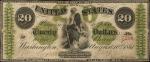
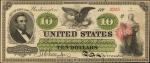
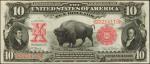

Friedberg 6a (W-1216). 1861 $10 Demand Note. PCGS Currency Very Fine 30.Offered is a vibrant $10 Demand Note payable at the office of the Assistant U.S. Treasurer in New York and displaying the handwritten "for the" after the hand-signed Treasury officials signatures. Demand notes were initially intended to be hand signed by the register of the Treasury and the treasurer of the United States. That practice quickly proved impractical, and soon other federal employees were pressed into service signing the notes. At first, signers would hand write "for the" after their signatures signaling that they were signing in place of the actual register or treasurer. Later the language was added to the actual printing plates. All handwritten "for the" Demand notes are quite rare today. The present offering is one of just five examples known of this catalog number, one of which resides in the ANA Museum collection leaving just four to the collecting public.<p>This is the finest graded note known for the catalog number. The paper is bright, displaying just modest circulation, while sharply printed inks accentuate this classic federal design type. The Treasury officials signatures are neatly penned in bold inks with the all important "for the" additions clearly displayed. The grading service mentions minor rust, seen primarily in a small area to the right on the face of the note. This is a wonderfully appealing note with a rich pedigree that includes names like Schermerhorn, Bass, and Anderson. One fortunate collector will be able to add their name among those numismatic luminaries when this note crosses the auction block.<p>The face of the $10 Demand Note features the portrait of Abraham Lincoln, his first depiction on a federal note, there being no restriction against placing the image of a living person on money. The engraving was by Charles Burt who utilized a photograph taken by C.S. German. At the top is a stock vignette of an American eagle created by Toppan, Carpenter and Company for use on state bank notes, passing to the American Bank Note Company in the merger of 1858. To each side is a green "10" counter. To the right is seen a standing woman, an artist with palette and drawing board, variously called Art or Painting. Patent imprints of 1857 and 1860, similar to those used on other Demand Notes, Legal Tender Notes, and certain other issues, refer respectively to the Patent Green Tint franchise held by the American Bank Note Company and the cycloidal configurations technique of the National Bank Note Company. Both claimed these deterred counterfeiting. As a class, Demand Notes were issued from August 26, 1861, to March 5, 1862.<p>The cities of the several Sub-Treasury offices-Boston, Cincinnati, New York (as here), Philadelphia, and St. Louis-are imprinted near the bottom center. <p>On the back the "greenback" design is largely geometrical and includes the counters "X" repeated many times and a lesser number of "TEN" imprints.<p><p><strong>PCGS Population: </strong>1, none finer.<em>From Robert F. Schermerhorn; Harry Bass Research Foundation; Bowers and Merenas sale of the Harry W. Bass, Jr. Collection, May 1999, lot 10; Lyn Knights sale of August 2005, lot 1007.</em>


