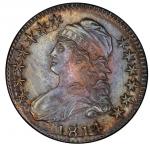
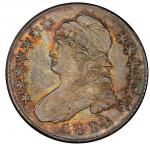

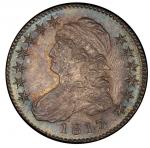


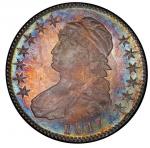
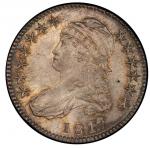
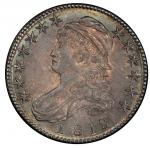
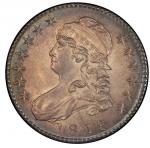

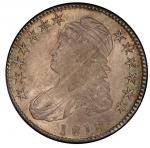
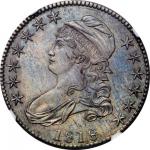
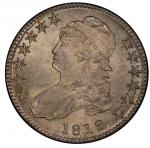
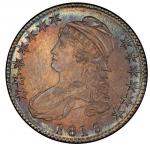
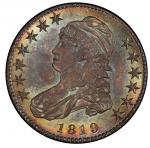
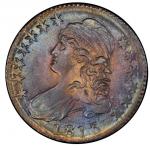
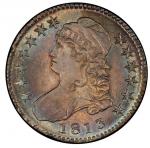
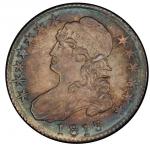
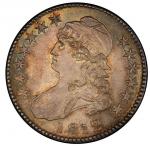
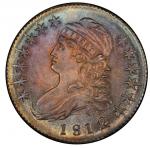
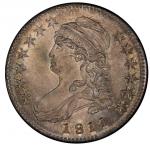
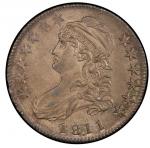
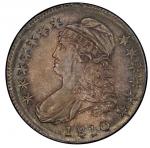
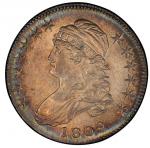
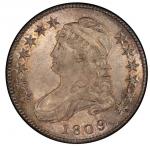
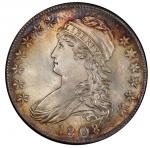
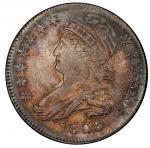
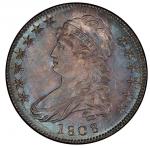
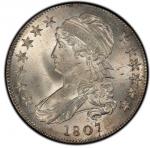
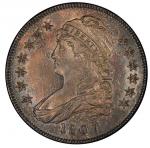

Come on, then, men of New York; let not hail, snow, rain or mud deter you; come in companies, pairs or singly; ride to this place if the distance be far, and pay me dollars, half dollars, shilling and six-pennys. -- Advertisement for the Eagle Tavern, Buffalo, New York, February 22, 1814..The vibrantly toned obverse displays violet surrounded by cool sea blue and ringed with bright gold and other rich tones. The reverse is a distinctive blend of springtime violet, autumnal rose and gold, bright pastel blue in the lower left, with traces of deep olive around the design elements. The surfaces on both sides are thoroughly lustrous, with full original cartwheel present and unbroken. Aesthetically appealing and warmly toned, scrutiny finds some minor hairlines, but no marks of consequence. Bold cracks and clash marks dominate both sides. Several sets of light clash marks are seen around the bust of Liberty, while the reverse shows much deeper impressions, most notably including several retrograde clashes of LIBERTY from Libertys cap, now present under the left wing. The obverse shows a heavy horizontal crack under the date, a fragile crack across Libertys cleavage, and a long bold arc that connects each of the stars via the folds of Libertys cap. In spite of the damage these weary dies have suffered, the strike is exceptional, with full centers on each star, crisp design elements, and fully defined denticles. The overdate is clearly seen under low magnification.While the feeder finger systems clearly needed work, the die shop was forging dies that were build to last, able to survive repeated clashings, cracks, and other abuse without completely falling apart. Just over one million half dollars were coined in 1814 from eight obverses and nine reverses, which averages to 129,884 strikes per obverse and 115,453 strikes per reverse. Only one 1814 variety is considered scarce today (Overton-106, Rarity-4+), so these numbers are probably not tremendously far off.The only 1814/3 certified at a higher grade at PCGS than this one is the Bareford-Pryor-Dr. Juan Soros-Phil Kaufman specimen, now in a famous Iowa collection. This one is at least tied for second finest known honors, though no other specimen aside from this one and the one cited has ever been graded finer than MS-64 by PCGS.