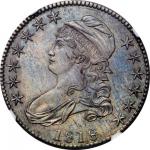
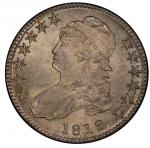
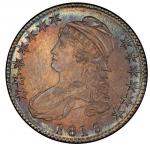
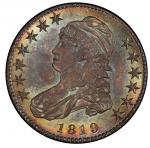
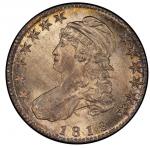
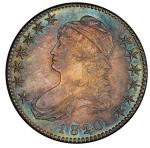
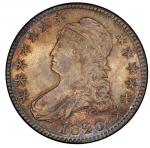
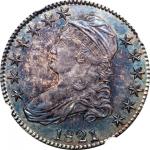
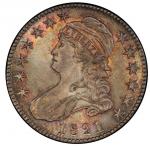
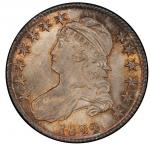
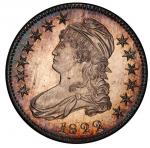
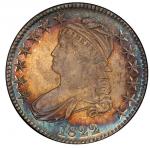

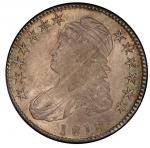

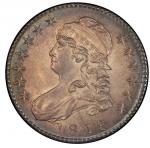
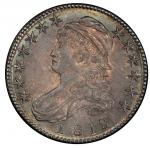
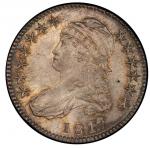
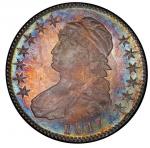


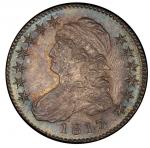

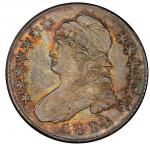
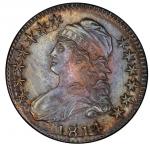
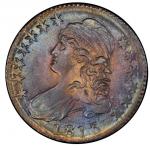
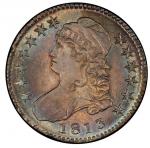
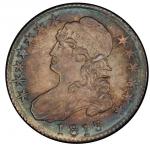

What used to make collectors furious and jealous was that the Colonel could and did buy almost anything he really wanted. -- Arthur H. Lewis, The Day They Shook The Plum Tree, 1963.Profoundly reflective and clearly produced with exacting consideration for its aesthetic impact, this extremely rare Proof half dollar was struck from freshly prepared dies on a heavily polished planchet. The response of any numismatist seeing this coin in hand is apt to be visceral, certain, and instantaneous, with their subconscious recognizing the stark contrast between the look of this piece and a typical Capped Bust half dollar of the era before the mind can even ponder it. The toning is beautiful, a match to the surface quality, dominated by sky blue with gold and flecks of violet. The splendidly detailed bust of Liberty floats in this mirrored sea, her mouth open, her tresses curved like cursive upon copperplate, the letters of LIBERTY on her capband finely and carefully polished on the die. Each star has found its center, and all peripheral details on both sides are elongated, as if squeezed from the die by force, including the denticles, the bases of the date digits, and the tops of the letters in the reverse legend. The effect of this well-considered strike and its well-polished canvas is remarkable.This planchet endured extensive polishing not only to create an exquisite product, but also to efface any evidence of the light inborn striations that were on its surface. A vestige of them may be seen at the high point of the central obverse, left of Libertys ear curl and below her ear, where even this vigorous strike could not apply sufficient pressure to completely obliterate them. Some similar striations may be seen on the Norweb Proof 1822 half dollar, also present in the Pogue Collection. The polishing effort left behind a short curved lintmark just below Libertys cheekbone, and a shorter lintmark is seen below the ribbon of Libertys capband.Handled with care since its mintage, this gem specimen shows only the most minor scattered hairlines. No major contact marks are noted in the fields, though magnification finds tiny "planchet chips," probably actually depressions left from foreign matter remaining on the die face after polishing. A possible contact point on the wing right of the eagle, hidden among the feathers, may also be the impression of a foreign object present at the time of striking.Importantly, this is the earliest die state for this die marriage. A substantial frosty bulge at the tip of the bust remains from the earliest attempts to efface two severe parallel lapping lines left of the 1 of the date. In later states, this bulge would become effaced with more finesse and is not seen on most surviving specimens. Likewise, the lapping line above the highest point of Libertys cap becomes less stark in appearance, though it continues to be visible in later die states. The later die states are more commonly seen, most easily discerned by the lack of the frosty bulge at the tip of the bust and the presence of stars being drawn to the rims. Another example of this rare early die state, cataloged with the notice that "we are unable to find any prior description" of the frosty bulge, was offered in Heritages August 2011 ANA sale. That piece, graded MS-65 (NGC), had satiny luster and surface, giving it an entirely different set of surface characteristics from this fine Proof example.Long held in the Eric P. Newman Collection before being sold via private transaction to D. Brent Pogue, this exceptional Capped Bust half dollar stands among the very earliest examples of the denomination with a claim to Proof status. While some cents dated 1817 have been accorded some measure of respect as Proofs, PCGS has traditionally been reticent to certify any Proof coin dated earlier than 1821 as a definitive Proof. In that year, enough Proof cents were made to derive a standard measure of "Proofness," a baseline defined by numerous data points. Before 1821, clear efforts were being made at creating Proof strikes, but the data is more disparate, the dots more difficult to connect.PCGS has never graded an 1818 half dollar in Proof, though their PCGS CoinFacts website estimates the grades of four pieces they have not certified. One of those is the George Earle - Eliasberg Overton-113, last sold in January 2013 and the only example certified by NGC as a higher grade than this one. Another, also an Overton-113, was sold in our 2002 Hain and 2006 Byers sales. That coin has long been attributed, even by Walter Breen, as the Thomas Cleneay coin. It is not; in fact, it is not even struck from the same dies. The Cleneay coin, sold in S.H. and Henry Chapmans legendary 1890 sale, is an Overton-107, the same variety as the present coin. The lack of contrast in the Cleneay plate, combined with the significant toning that has developed on this specimen over the last century, prevents certain linkage. They may be the same coin, they might not be, but it is certain that they were struck from the same dies. If this is not the Cleneay coin, it begs the question: where is it?The two 1818/7 overdate Proofs noted in the Breen Proof Encyclopedia, namely the Alto-E. Yale Clarke Overton-101 and the T. James Clarke-R.E. Cox Overton-102 were included in the 1983 Dr. George F. Oviedo Jr. Collection sale, but they have not been studied or offered since. Neither has been certified as Proof by either PCGS or NGC. Their Proof status may be deemed questionable until such time that they are made available for study and comparison to modern Proof standards. Breen cataloged the Clarke-Cox coin skeptically in New Netherlands Coin Companys 47th sale in 1956.We can confirm only the following Proof 1818 half dollars:..<strong>Overton-107:</strong>This coin. NGC Proof-65.The Cleneay (1890) coin. Almost certainly the piece offered in the February 1961 Kriesberg-Schulman sale, though the abysmal plate quality of that catalog does not allow for absolute certainty...<strong>Other varieties:</strong>National Numismatic Collection at the Smithsonian Institution. Overton-112.The Winsor (1895)-Earle (1912)-Eliasberg (1997) coin, NGC Proof-66. Overton-113.The Hain (2002)-Byers (2006) coin, NGC Proof-65. Overton-113..Owned by legendary collectors Col. E.H.R. Green and Eric P. Newman, this coin has no known auction provenance. It has sold strictly via private transactions since at least the 1930s and probably for decades earlier. Had numismatic photography been pioneered a half-decade prior to its 1868 debut, we could perhaps determine that this was the "Splendid Proof" described in W. Elliot Woodwards 1864 John F. McCoy sale that sold for $5.