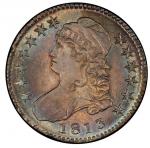
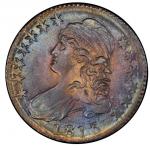
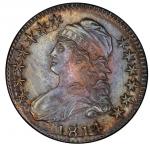
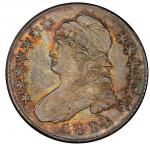

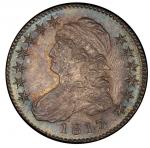


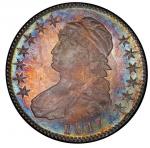
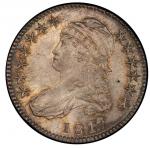
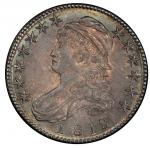
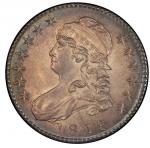

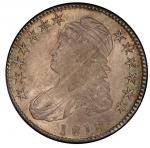
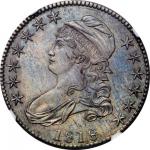
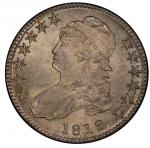
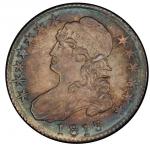
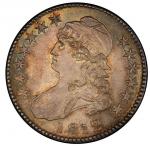
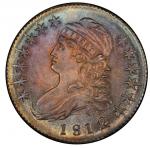
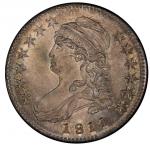
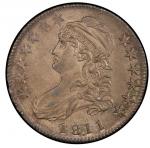
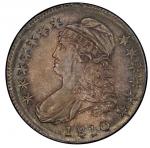
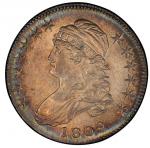
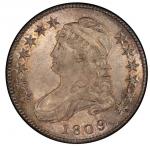
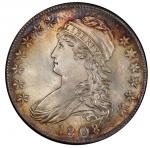
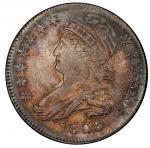
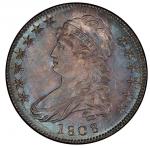
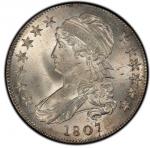
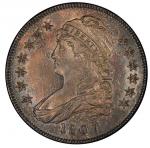
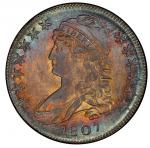

The specie in the Boston banks swelled from less than eight hundred thousand dollars in 1812 to more than seven million dollars in 1814. -- John Bach Macmaster, A History of the People of the United States, from the Revolution to the Civil War..Impressive cartwheel luster spins over exquisitely blended pastel-toned surfaces, with gray centers revealing understated violet and gold highlights, ringed with concentric arcs of blue and champagne gold on the obverse, while the reverse displays bolder azure at the peripheries. A superb gem example, this half dollar is an aesthetic treat whose preservation exceeds that of more typical specimens in this grade range. Concerted effort finds a few short lines on Libertys cheek and a single short scratch above star 7, but little else of consequence. Insufficient metal flow has left an area of Libertys bust and the reverse portion opposite it, near D of UNITED, softly struck and containing some original planchet texture, as struck. Sharply struck and ringed by a strong perimeter of denticles on both sides, the central devices stand out firmly from the pristine fields. Stars 1 through 4, at left, lack their centers, but other fine details are fully realized. A single die clash has left traces in front of Libertys profile and behind her head, along with a retrograde impression of LIBERTY under the wing at right and an outline of Libertys bust above it. The reverse die is lightly cracked through the olive leaves and the top of 50, while another crack begins at the rim below the olive leaves and joins the centers of UN to the bases of ITED.With its stunning quality and picturesque toning, this example spectacularly represents a year of great historic consequence for the United States. Mr. Madisons War, the War of 1812, entered full swing in 1813, with long-lasting effects on the American economy. While the frontier and border regions had to concern themselves with British-sponsored native incursions, and the coastal South began to suffer from the British blockade, certain industries in New England prospered, taking advantage of the opportunity to trade with both neutrals and the enemy. Northern manufactures kept the South supplied at high prices, as the South was unable to move its agricultural products anywhere but New England. All manner of specie poured into New England while the rest of the country went without, dependent largely upon paper money for local commerce. Many of the high grade half dollars of this era probably first found sanctuary in the vaults of Boston banks, and gems like this may have remained there a half-century until the burgeoning numismatic marketplace placed a premium value upon them.The Garrett-Pryor coin, sold as an uncertified MS-66 in 1996, has long been considered the standard-bearer for this variety, though if it has been submitted to PCGS at some point in the last 19 years (a likely but perhaps not certain scenario), it has not graded any finer than MS-65. The only 1813 half dollar graded finer than this one at PCGS is the Newman Overton-107a.