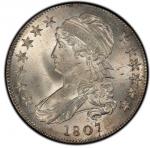
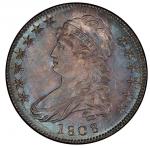
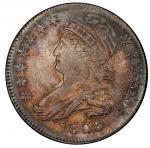
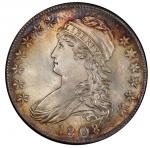
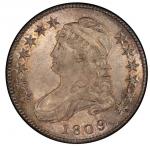
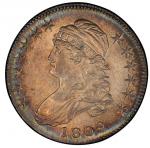
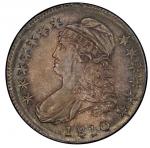
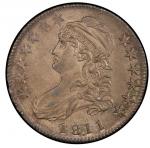
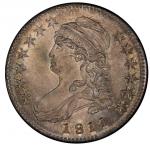
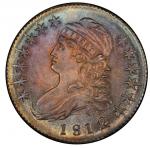
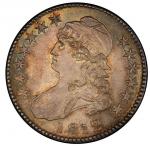
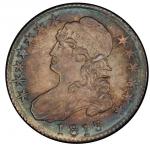
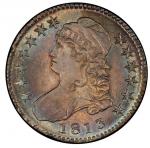
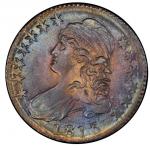
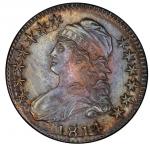
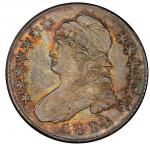
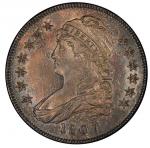
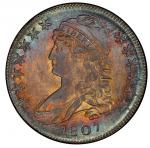

Mr. Reich is now preparing a set of new dies in which some improvements in the devices will be introduced, (adhering, however, strictly to the letter of the law) which it is hoped will meet with public approbation. -- Director of the Mint Robert Patterson to Thomas Jefferson, April 2, 1807..A fully brilliant gem -- a tangible time machine to 1807. Looking now much as it did the day it left the Philadelphia Mint, this piece displays extraordinary cartwheel luster on both sides. A whisper of surface toning is seen along a peripheral arc from left of the date counterclockwise to stars 10 through 13. Some areas of the reverse also show a minimal haze of toning, but this piece is mostly brilliant on obverse and reverse. A few tiny dark planchet flecks are seen, chiefly at center and in the right obverse field. The strike is strong, just a bit soft on the eagles head and the area of the wing near the upper left corner of the shield, but bold and well-defined among the stars and other areas of the central and peripheral designs. A few hairlines are seen, mostly on the obverse, where we note a shallow scratch from star 4 into the obverse field near the chin. Two white spots, each a tiny perfect circle, are present at the final S of STATES. What appear to be shallow abrasions above 07 of the date and above star 13 are likely mint-made depressions. Both obverse and reverse show evidence of a single clash. Two lumps from die spalling are seen under the 7 of the date, another outside star 11.<span style="line-height:1.5;">Capped Bust half specialists and PCGS agree that this specimen is the finest known from these dies, a primacy of preservation that PCGS extends beyond the variety to encompass all examples of the 1807 Capped Bust issue. Stephen Herrman has noted this example as the finest known of the variety in his compiled data, and it stands as the sole 1807 half dollar of any variety to reach the MS-66 level at PCGS. It is finer than the Col. E.H.R. Green-Eric Newman Overton-114, sold for $152,750 as MS-65 (NGC) and recently graded at the same level by PCGS. It also surpasses the Overton-112 included in the Jimmy Hayes and Marvin Taichert type sets, a coin Congressman Hayes once noted was one of only two specimens of the date he had ever seen "that really qualified for full Unc. status." Widely recognized as the very finest survivor from this first-year issue, this coin attracts particular interest from those like Jimmy Hayes who specialize in first-year type coins.</span>The John Reich design revolution began in 1807 with half dollars and half eagles, but eventually expanded to include every series but eagles and dollars, two denominations that endured a production lapse that would extend to the late 1830s. Reichs relationship to the U.S. Mint dates to 1801, when Chief Coiner Henry Voigt purchased the remainder of Reichs indenture, a term of servitude that would have enabled Reich to pay for his voyage from Bavaria to Philadelphia with a guarantee of future labor. Mint Director Elias Boudinot wrote to Thomas Jefferson in June 1801 that Reich "has been liberated from his servitude by means of one of the officers of the Mint, since which I have set him to work on a particular medal to be ascertained of his abilities. I am obliged to use great precaution in regard to employing him in the Mint before I can have good evidence of the integrity of his character." The medal mentioned by Boudinot is likely Jeffersons Indian Peace medal, though soon thereafter Reich began work on the project that would attract Jeffersons more specific attention: a privately commissioned medal to commemorate both Jeffersons inauguration and the 25th anniversary of the Declaration of Independence. Jefferson was so pleased with it that he sent one to each of his daughters, writing to Martha "I inclose you a medal executed by an artist lately from Europe and who appears to be equal to any in the world," noting further that "it sells the more readily as the prints which have been offered the public are such miserable caricatures."The next several years of Reichs career were mostly spent on odd jobs, engraving now-forgotten seals and dies for better-remembered medals, including government-sponsored projects, like the naval medals for commodores Thomas Truxtun and Edward Preble, and private commissions, led by the four medals depicting George Washington and Benjamin Franklin that were executed as part of Joseph Sansoms abortive Medallic History of the American Revolution series. He was finally hired full time by the Philadelphia Mint on April 1, 1807, with the title of assistant engraver and a salary of $600 per annum. The designs for the 1807 Capped Bust half dollars were among the first works he completed in his new position, though he completely re-envisioned and created the designs for the new half eagles in the same year. In 1808, Reich redesigned the cent and the quarter eagle; the year following, his talents brought forth new images of Liberty on the half cent and dimes. After 1807, no quarter dollars were struck until 1815, but when they appeared those too were struck from new designs by Reich, completing his total overhaul of American coinage. Though he left the Mint in 1817, when the half dime reappeared in 1829, it likewise displayed motifs copied from the work accomplished during his decade of active production. Stewart Witham, a Capped Bust half dollar specialist and Reich biographer, estimated that during that decade Reich "executed at least 270 different coin dies, obverses and reverses." It is no wonder that the specialty club devoted to collecting the coins of this era selected the name John Reich Collectors Society.The Capped Bust half dollar remains the most avidly collected of Reichs designs. The D. Brent Pogue 1807 Large Stars half dollar is the single finest survivor of the largest and most popular coin designed and struck during Reichs first year as a US Mint engraver..