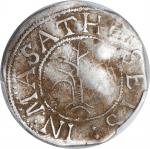
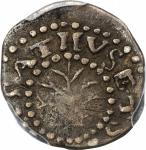
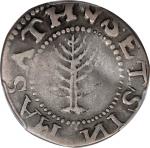
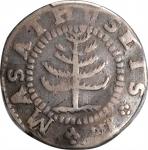
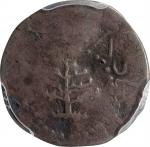

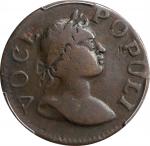
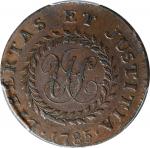
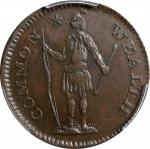

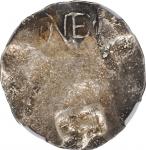
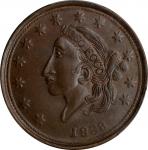

1652 Oak Tree Sixpence. Noe-17, Salmon 4-X, W-370. Rarity-6+. IN on Obverse, Hydra Tree. AU Details--Damage (PCGS). 34.0 grains. Offered is one of the most significant Massachusetts Bay Colony silver coins of any type or denomination to appear in our recent sales. While not a perfect example in many ways, it is still a well made and overall sharply defined survivor of the rare and enigmatic Noe-17 Oak Tree sixpence variety. Many of the design elements on both sides are essentially full, in fact, and the only mentionable lack of detail is over the upper right obverse and at the left reverse border, these areas being in opposition since the reverse is rotated a full 90 degrees clockwise from coin alignment. On the obverse, the upper right portion of the tree shows little detail and the letters VS in MASATHVSETS are soft, yet legible. For the reverse we note that the letters AND in ENGLAND are absent. The planchet is noticeably wavy with an irregular shape that is most jagged around the obverse from 1 to 5 oclock, these features generally as made. The trunk of the tree, among other elements, remains sharp to confirm the Noe-17 attribution (as opposed to the even rarer Noe-17.5).<p>Regarding the PCGS qualifier of "Damage," it is used here as a catch-all phrase to describe a coin that has been dug and then "conserved" to some extent. The latter refers to cleaning, done to remove encrustation, although the more protected areas on the obverse retain appreciable ruddy patina. There are no sizeable marks, however, and the in hand appearance is quite smooth if one accepts the aforementioned planchet waviness and irregularity of shape.<p>The exact origin and nature of this variety has been debated by numismatic scholars. Christopher J. Salmon sums up the debate when he writes: "The 4-X (Noe 17; Noe 17.1; Noe 17.5) and 5-X (Noe 18) Oak Tree sixpence varieties are also extremely problematic and appear to be counterfeits, though not all authorities agree with this conclusion." The varieties are related, for sure, since Noe-18 is a reworking of Noe-17, after the former moved through Noe-17.1 and 17.5 reworkings of its own. Elaborating further, our own John Kraljevich had this to write (regarding Noe-18) in his cataloging for our March 2015 sale of the Henry P. Kendall Foundation Collection:<p><em>"Salmon and some others have argued that this variety was not struck at Hull and Sandersons mint, casting the same aspersion on Noe-15 and Noe-17. We find the identical weight standard, letter forms, striking methodology, die recutting methodology, depth of engraving and strike, and overall fabric to be powerful evidence to the contrary."</em><p>While the issue may never be settled to everyones satisfaction, the rarity of the attribution and the intrigue that surrounds it guarantees Noe-17 a place of prominence on the want lists of advanced Massachusetts silver collectors.<p>Due to additional finds, Noe-17 has been at Rarity-6+ for much of the last five to 10 years. Many of these have been for low grade and/or impaired pieces, a number of which are ground finds. The present example, in fact, is a recent newcomer to the census, was dug by our consignor, and is being offered for the first time in this sale. Since at least three examples are impounded (ANS, BMFA, and Museum of Connecticut History), there are perhaps just a dozen to 15 available for private ownership. With far more detail than most, this new discovery certainly has much to offer and is sure to see spirited bidding.<p>The name "Hydra Tree" for this variety, which is included on the PCGS insert, is attributed to Michael J. Hodder. PCGS# 909045.
*拍品信息由各家拍卖公司提供,首席数据中心刊载出于传递更多信息之目的,并不意味着赞同其观点或证实其描述。