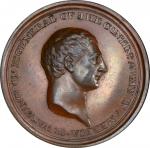

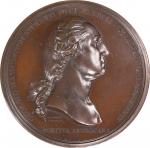
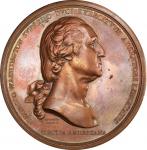
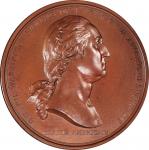
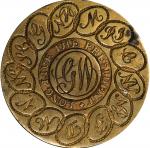
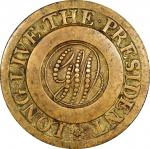
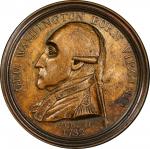
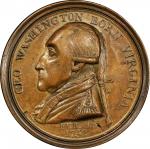

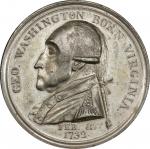
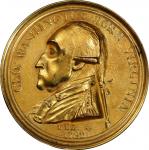
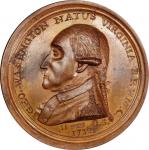
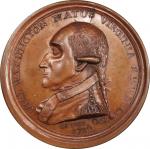
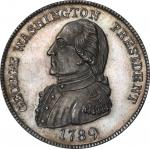
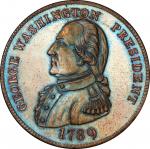

Circa 1777 Voltaire medal. Musante GW-1, Baker-78B. Copper. MS-64 BN (PCGS).40.1 mm. 334.4 grains. A really handsome specimen of this classic medal. The surfaces are gently mottled with tones varying from deep tan to rich chocolate to reddish mahogany bronze. The highest areas of relief on the portrait have taken on a slightly darker patina. Appealing surface gloss is noted on both sides and there are virtually no marks to speak of beyond the faintest evidence of handling seen under magnification. These medals are often found with irregularities in the rims that probably speak to less-than-ideal equipment being used in their production, but such is not the case here. The rims are nicely developed and even. Nicely struck with good detail throughout. The dies are in a later state with the usual roughness at the center of the main flag on the reverse, but also a crack that extends from the reverse rim inward near the rear of the cannon. Gentle sinking of the obverse die has resulted in a minor buckling in the obverse fields.<p>This has long been referred to as the Voltaire medal and is considered the first of the Washington portrait medals. Both facts are rather ironic since it is highly unlikely that Voltaire had any hand in this medal’s authorship and the portrait seen here is most certainly not that of George Washington. As more attention has been given to this medal in recent years, considerable research has attempted to understand the peculiarities of this medal. Surveying such is a rather fascinating endeavor. It has long been believed that this medal was a French product and that Voltaire himself was the driving force behind it. On the surface, this would make sense considering the French legend which incorporates Voltaire’s own words on the reverse, taken from his 1723 epic poem, <em>La Henriade</em>. Further, an April 1778 notice in the <em>London Chronicle</em> seems to seal the story by advising that, “A medal has been lately struck at Paris, by direction of Mr. Voltaire, in honour of Gen. Washington…,” continuing with specific descriptions of the devices and legends of this piece. However, it has been illustrated in recent years that Voltaire almost certainly had no hand in this medal, that it was actually struck in England (remarkably so, considering the subject, sentiments and time period), and that it is one of a very small series covering subjects that include Benjamin Franklin, Scottish philosopher David Hume, and the fascinating French diplomat and spy known as Chevalier d’Eon. The details connecting these medals are nicely presented in Neil Musante’s recent book, <em>Medallic Washington</em>, and we won’t recount them here beyond noting Musante’s most critical observation. It was illegal for medals to be struck in France at the time in any facility other than the Paris Mint, and there is no record of such a medal having been produced there. While there is seemingly good reason to abandon the old “Voltaire medal” name, we maintain it here in the interest of the long tradition and its wide recognition among collectors.Ex William Spohn Baker Collection, to the Historical Society of Pennsylvania by bequest, November 15, 1897.
*拍品信息由各家拍卖公司提供,首席数据中心刊载出于传递更多信息之目的,并不意味着赞同其观点或证实其描述。