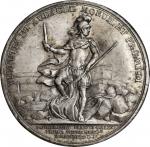
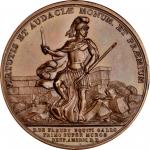



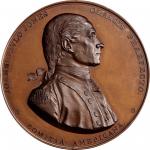
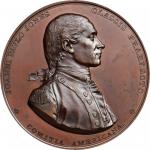
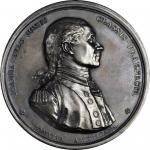
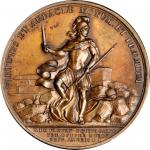
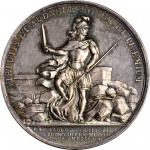
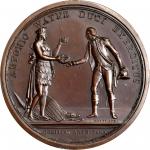

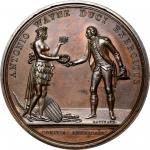
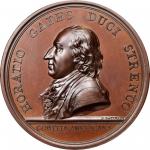


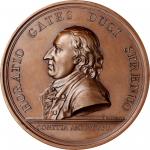
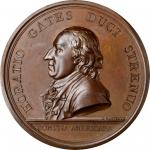
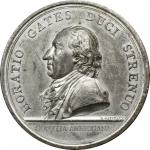


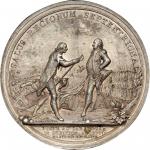

1779 (April 20, 1780 - May 4, 1780) De Fleury at Stony Point obverse cliche. As Betts-566. White metal. Original dies. Workshop of DuVivier. 44.8 mm, 230.2 grains. 1.3 - 1.4 mm thick. About Uncirculated.Trimmed irregular edge. Plain back covered in a base level of paper, from a scrap written on in ink, and secondary level still present at center. One of just two De Fleury cliches known in private hands, and perhaps one of two anywhere. Neither Adams-Bentley nor Stahls listing in the ANS COAC mention any cliches of either the De Fleury obverse or reverse. The surfaces are an appealing and even glossy antique gray, showing some gathered surface dirt but no major flaws. The eye appeal is wholesome and original, and a glass detects only a few dull old marks in the fields and among the bricks left of the centurion.<p>This cliche shows DuViviers original design, which was slightly modified before striking finished medals. The exergual legend, as seen here, reads D. DEFLEURY EQUITI GALLO / PRIMO SUPER MUROS / R.F. AMERIC. D.D., a substantially different layout than seen on the finished medals, which read D DE FLEURY EQUITI GALLO / PRIMO SUPER MUROS / RESP. AMERIC. D.D. As it turns out, the change in the exergue explains the reason this cliche exists - and shows the extent to which Franklin was involved in this medals design process.<p>DuVivier wrote to Franklin on April 20, 1780, to report that De Fleurys medal had been completed, but also asked Franklin to come look at the proofs (i.e. cliches) of the unhardened dies "to take advantage of your opinions while there is still time: "je desirerois avant de faire tremper les coins avoir lhonneur de vous en montrer les Epreuves pour profiter de vos avis pendant quil en est encore temps." As Adams and Bentley noted "Franklin accepted the artisans offer because he wrote back requesting him to correct the defects in the lettering," telling DuVivier, as translated by Adams and Bentley, "I have shown the proofs of the medal to several persons who find them good, with the exception of the letters in the exergue. These are so irregular that I ask you to correct them if possible." These letters from Franklin allow this cliche to be dated to the brief period from April 20, when DuVivier asked Franklin to view the "epreuves," to May 4, when Franklin asked for the design as shown here to be slightly modified.<p>This remarkable historical paper trail, direct from Franklins pen, makes this cliche one of the most desirable of all Comitia Americana cliches known. The other known De Fleury obverse cliche was struck from the identical pre-modification die state and was discovered in France in 2013. It sold in our November 2017 Baltimore sale, as lot 8, for $10,800.<p><p><strong>A Note On Trials: Cliches, Epreuves, and Splashers </strong><p>The Adams Collection of Comitia Americana and related medals is uniquely enriched by several specimens of a unique form of medallic production that is known by several different names. Typically struck from a die in its earliest state, usually before hardening, these trials were called epreuves - proofs - in the original French correspondence between Dupre and Duvivier and the Founding Fathers charged with the acquisition of the medals the Continental Congress authorized. In more modern numismatic literature, they are more often called cliches or splashers, the latter term being a fair description of just how these trials were made.<p><p>Unhardened dies are incredibly susceptible to damage, as 18th century die steel (and modern steel today) is brittle before it is hardened by quenching. Once a die is hardened, modification becomes very difficult, so if changes need to be made, they need to be done in that fragile, unhardened state. Engravers in major mints - Paris especially - were accustomed to making soft metal impressions as something of a proofreading copy, enabling the negative die to be viewed in the positive in rough draft form. Wax impressions were liable to leave bits of wax in the interstices of design elements, thus engravers settled upon tin (usually called "white metal" in modern numismatic circles) as the best medium.<p><p>Tin melts at 450 degrees Fahrenheit, a low enough melting point to be accomplished in any small workshop. A ladle full of molten tin poured onto a surface will cool and harden fairly quickly, but remain soft long enough that a die can be easily pushed into it by hand, leaving a relatively durable impression in medal. Most often, medalists would find a piece of scrap paper - a note, a newspaper, a book page - to pour the tin atop, thus preventing their workspace from getting scorched and making the tin sheet somewhat easier to lift and trim. <p><p>These splashers were not intended to be medals, or even permanent, but simply a temporary way to display the state of the die in the positive before its devices were rendered immovable. Each was personally crafted by the engraver in his shop. In the case of the Comitia Americana medals, the epreuves made by Duvivier, Dupre, and Gatteaux were ultimately intended to be viewed and handled by themselves and those close to the process. Benjamin Franklin reviewed the epreuves of the De Fleury medal between April 20 and May 4, 1780, then made recommendations regarding the lettering in the obverse exergue that were adopted by Duvivier. He later did the same with his Libertas Americana medal, correcting a spelling error on the reverse. Engraver Augustin Dupre retained many of his splashers in his personal collection, some of which found their way into institutions in France and the United States, some of which are in the present sale.<p><p>Thomas Jefferson used cliches as a spendthrift (and lightweight) way to collect all the medals of the Comitia Americana series, assembling a set for himself and another for his Virginia countryman James Madison. As he was preparing to depart Paris in September 1789, he wrote to Madison to let him know of the boxes he was shipping, including a box of books and several crates full of Houdons John Paul Jones busts that the sitter wanted to have distributed in America. <p><p><em>I have put a collection of the proofs in tin of the medals voted by the U. S. (except two, of which the dies are in America) the medals themselves not being allowed to be taken, I desired the workmen to let me have two sets of their last proofs; for their manner is, as their work proceeds, to make impressions of it in pure tin, in order to correct &c. These proofs are in fact more delicate than the medals themselves, and the last of them shew the impressions complete. I have had them arranged in a frame, under glass &c. & beg your acceptance of them.</em><p><p>By "delicate," Jefferson did not mean fragile, but well-detailed. The modern whereabouts of these sets are unknown; it is very possible that some proportion of either of these sets are in the current sale.<p><p>Jeffersons set left Monticello in February 1798 in the hands of an enslaved man named York, who Jeffersons son-in-law and overseer, the abusive drunkard Thomas Mann Randolph, called "allmost (sic) an idiot." Randolph told Jefferson that the thief had confessed, listing off an inventory of items from Jeffersons chambers including "some impressions in lead & tin of Dies of the Medals & Coins." He continued "I have some hope of recovering the proofs of Medals (tis from the description I conclude they are out) I have traced one to a Negroe of the neighbourhood who bt. it of York but he says he has lost it." The historical record on the theft and recovery thereafter falls silent; Jefferson wrote several consecutive letters to Randolph after the receipt of this letter but never acknowledged the incident. Two different men named York were enslaved by Jefferson concurrently, one of whom was inherited from the estate of Jeffersons father-in-law in 1774 and described as a "Waterman," the other of whom was born in 1781 and labored at Monticello. Presumably the York involved here was the latter of these two, aged 17 at the time of his act of resistance against Jeffersons authority.<p><p>Today, cliches of each of the Comitia Americana medals are extremely rare, with populations in the low single digits. There is not a single issue in this format that is known to the extent of 8 or 10 pieces. Matched sets of obverse and reverse are the exception rather than the rule. Each of the survivors is an accident, a piece that was made to serve a purpose at a moment in time, not produced for long-term preservation in a cabinet. Their historicity is exceptional, as each survivor was not only in the hands of the medals engraver, but likely in the hands of Thomas Jefferson, Benjamin Franklin, David Humphreys, or a small number of others. Their rarity surpasses that of their normally struck cognates in nearly every circumstance.<p><p>With the possible exception of the Charles Senter Collection, sold at auction in 1933, no cabinet has ever included such a wide array of these historic rarities as the John Adams Collection.<p><strong>The Battle of Stony Point</strong><p><strong>The Action: </strong><p><p>One need not be a military mastermind to look at a map and understand the strategic importance of the Hudson River. From New York Citys seaward port to the Canadian border, the Hudson River acts as a wet superhighway, navigable for all but a 12 mile overland portage from the falls of the Hudson to the southern tip of Lake George, whose northern end connects to Lake Champlain at Fort Ticonderoga. Control of this waterway could effectively cleave New England from the mid Atlantic states and thus manage the entire Northern theatre of the American Revolution.<p>When two minor forts along the Hudson fell into British hands in May 1779, Washington was alarmed. Sir Henry Clintons forces captured Verplancks Point and Stony Point, across the river from each other at a narrow choke point 12 miles downriver from West Point. The forts themselves werent of great importance, but they represented the termini of Kings Ferry, the main commercial path across the Hudson in the region. With West Point fortified to command the river, and Washingtons main army in the area, it was important to retake what was lost.<p>Washington worked quickly, asking Pennsylvania Line commander Gen. Anthony Wayne to lead an expedition against Stony Point, on the west side of the river. The British position was atop a hilly peninsula that was accessible only from the low swampland to the west. Wayne built a small force of infantry and engineers to retake Stony Point. The 1,150 men of the Light Infantry gathered in the middle of the night under a veil of darkness and silence; Wayne is said to have had dogs in the neighborhood killed so none would sound an alarm. Muskets were unloaded and bayonets were fixed, giving Wayne not only the advantage of a quiet approach, but also a chance to avenge the bayonet massacre near his Pennsylvania home that became known as the Battle of Paoli. "Remember Paoli" became one of the rallying cries of his force as they put their bayonets to use at Stony Point.<p>Wayne commanded the full body of troops, while the right and left advance guards were commanded by the patrician French engineer Lt. Col. Francois De Fleury and Major John Stewart, respectively. De Fleury was the first to breach the forts earthworks and grab the British flag, yelling "The forts our own!" When Wayne wrote to Washington at daybreak to report the victory, he told the general "our officers and men behaved like men who are determined to be free." <p>Wayne and his men had captured valuable supplies, more than 500 British soldiers, and 15 artillery pieces in 25 minutes of brisk action, losing just 15 killed. This was not a major battle, nor was it a major victory, but its success nonetheless delighted Washington and the members of the Continental Congress, none of whom had gotten much good news during the 1779 campaign season. Wayne, De Fleury, and Stewart were all voted medals just days after the taking of Stony Point.<p><strong>The Resolution:</strong><p><em>Resolved, unanimously, That Congress entertain a proper sense of the good conduct of the officers and soldiers under the command of Brigadier General Wayne, in the assault of the enemys works at Stoney Point, and highly commend the coolness, discipline and firm intrepidity exhibited on that occasion.</em><p><em>Resolved, unanimously, That Lieutenant Colonel Fleury, and Major Stewart, who, by their situation in leading the two attacks, had a more immediate opportunity of distinguishing themselves, have, by their personal achievements, exhibited a bright example to their brother soldiers, and merit in a particular manner the approbation and acknowledgment of the United States.</em><p><em>Resolved, unanimously, That Congress warmly approve and applaud the cool, determined spirit with which Lieutenant Gibbons and Lieutenant Knox led on the forlorn hope, braving danger and death in the cause of their country.</em><p><em>Resolved, unanimously, That a medal, emblematical of this action, be struck:</em><p><em>That one of gold be presented to Brigadier General Wayne, and a silver one to Lieutenant Colonel Fleury and Major Stewart respectively and that five thousand of copper be struck for Congress.</em><p><em>- Continental Congress Resolution of July 26, 1779</em><p><strong>De Fleury at Stony Point</strong><p><strong>The Acquisition: </strong><p>The only foreign officer to receive a medal for heroism during the American Revolution was also the first to receive his finished prize. Robert Troup, the secretary of the Continental Congress Board of Treasury, wrote to Benjamin Franklin in Paris in September 1779 to ask him to begin work on several medals: "The impracticability of executing the Work in this part of the World obliges the Board to forward them to you with an earnest request to have the Medals voted struck as soon as possible with such Devices as may be judged emblematical of the Occasions which excited the Notice and obtained the Thanks of Congress." Troup also requested that the dies be forwarded to America as soon as possible.<p>Within just a few months, Lt. Col. De Fleury was already writing to Benjamin Franklin dictating the inscriptions for his silver medal and requesting that a specimen be delivered to King Louis XVI.<p><em>Sir</em><p><em>The king has dezired me to send to him my medaille; I did answer, you had Received order to have it struck; & that as soon it would be done, I should present it to him. </em><p><em>If it was possible it Could be struck next week, I would be much obliged to you. Or if you have too much business, give me that Care; tell me the price you intend to put to it, & I shall Carrefully follow your directions.</em><p><em>I Could wish in one side the fort of Stonypoint, with this motto. aggeres, paludes, hostes victi. On the other side. A crown of Laurels, with a flag Struck. & this motto- Corona muralis. Round it, the united States to L. C. Fleury.</em><p><em>I beg you would answer to Me as soon as possible, & believe me very Respectfully your Most obedient humble servant</em><p><em>Fleury</em><p>Franklin, ever eager to please the French, set to work at a pace that was unusual for him. He wrote De Fleury in January 1780 to ask for help locating a proper medalist. There is no record De Fleury was helpful in that regard, but in March 1780 the well-born officer wrote to Franklin to inform him that he would be rejoining his regiment but that his medal could be left with his father. De Fleury also asked if a gold medal could be struck at his own expense. "It will not hurt the dies," De Fleury wrote, "I leave the money for that purpose in the hands of the medalist. He will keep the gold medal for me till my return."<p>While Franklin had De Fleurys medal struck with some of the inscriptions he had requested - Aggeres Paludes Hostes Vici does indeed appear on the reverse of his medal around an image of the fort at Stony Point - he does not appear to have satisfied De Fleurys ego by allowing a medal to be struck in gold, a composition intended exclusively for those of a generals rank and not their junior officers, no matter how wealthy or influential.<p>Pierre-Simon Duvivier wrote to Franklin on April 20, 1780, to report that De Fleurys medal had been completed, but also asked Franklin to come look at the proofs of the unhardened dies "to take advantage of your opinions while there is still time: "je desirerois avant de faire tremper les coins avoir lhonneur de vous en montrer les Épreuves pour profiter de vos avis pendant quil en est encore temps."<p>Within a month, the medals had been struck, as Duvivier reported to Franklin in a letter dated May 27, 1780. Franklin wrote home to Samuel Huntington, President of the Continental Congress, on May 31 to pass along the news. "The Medal for M. Fleury is done and deliverd to his Order, he being absent." Duvivier displayed the medal at the Salon of 1781. De Fleury was given the medal upon his return to France in August 1783.<p>The Presentation:<p>On April 15, 1783, Benjamin Franklin sent the medal to De Fleury, along with the following letter, written in French (translated here into English):<p><em>Sir,</em><p><em>I have the honor to send you, in accordance with the orders of the Congress, the Medal which they ordered me to have struck, in memory of your good action at the attack of Fort Stony-Point, to present it to you on their behalf.</em><p><em>I fulfill this duty with pleasure, having myself a high opinion of your merit. I desire you to carry for a long life this honorable mark of their consideration.</em><p><em>I am, with great esteem, &c.</em><p><em>B. Franklin</em><p>Franklins letter was republished in the French press in the autumn of 1783, leading the editors of Franklins papers to wonder if the letter was written by Franklin in 1780 but republished with an edited date by the newspapers of the time. Your cataloger suspects its more likely that the medal was held by Duvivier, retrieved by Franklin in 1783, and presented upon De Fleurys return in that year.<p><strong>The De Fleury at Stony Point Medal:</strong><p><strong>Obverse:</strong> De Fleury, depicted as a Roman centurion, raises a short sword in one hand while upending the British flag with the other, standing triumphant in the rubbled debris of the fort at Stony Point. VIRTUTIS ET AUDACIAE MONUM. ET PRAEMIUM or "A monument and prize for virtue and boldness" surrounds the periphery, while the densely packed exergue reads D DE FLEURY EQUITI GALLO PRIMO SUPER MUROS RESP. AMERIC. D.D. or "to the French officer De Fleury, the first to conquer the walls, given by the American Republic."<p><strong>Reverse: </strong>A fantasy depiction of the fortification atop Stony Points mountainous plateau, with six ships in the Hudson beyond and a positively enormous flag inside the right wall. The legend, as requested by De Fleury himself, reads AGGERES PALUDES HOSTES VICTI or "Fortifications, swamps, and the enemy overcome" with an exergual inscription STONY PT. EXPUG. XV JUL MDCCLXXIX or "Stony Point taken 15 July 1779." The overall design resembles that of the 1758 Oswego Captured and other earlier French military medals.<p><p><p>From the John W. Adams Collection. Acquired from our sale of the John J. Ford, Jr. Collection, Part XIV, May 2006, Lot 201. Earlier, from Charles McSorley on November 6, 1965.
*拍品信息由各家拍卖公司提供,首席数据中心刊载出于传递更多信息之目的,并不意味着赞同其观点或证实其描述。