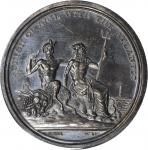
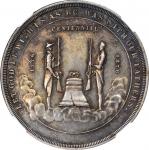

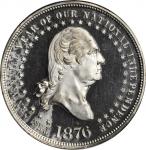
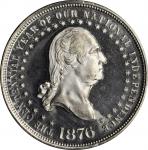
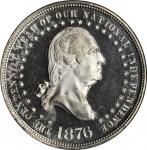
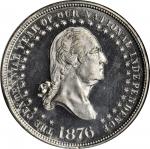
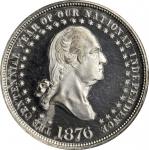
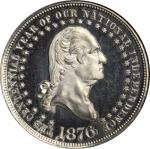
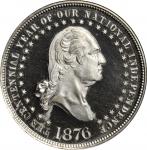
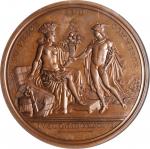

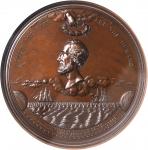
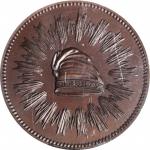
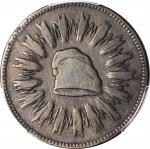
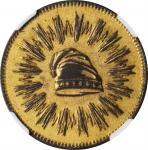
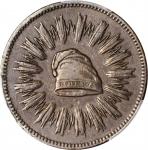
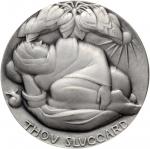

1826 Erie Canal Completion. Silver. 45 mm. HK-1000. Rarity-6. Specimen-61 (PCGS).A richly original, highly appealing example of this scarce and eagerly sought type. Both sides are deeply toned in a bold blend of steely-charcoal and copper-gray, although the fields readily reveal a lively reflective finish as the surfaces dip into a light. The design elements are crisply impressed with razor sharp detail and a soft satin texture. Wispy handling marks are noted for accuracy and, while they explain the numeric grade assigned by PCGS, many are well concealed by the toning. The in hand appearance is quite smooth, in fact, and this is certainly a handsome and inviting piece that is worthy of the strongest bids.When completed on October 26, 1825, the Erie Canal was an engineering marvel that was nearly four decades in the making, having first been proposed in the 1780s. The canal connected Buffalo and the Great Lakes in the west to Albany and the Hudson River in the east, and by extension to New York City and the Atlantic Ocean via the Hudson River. Its completion ushered in an era of economic, cultural and political prosperity in New York and specifically New York City, whose increasing importance as a port city outpaced those of competing ports along the eastern seaboard. The Canal was famous for bringing the agricultural products of the western interior to markets in the east, and bringing finished goods from the port of New York City to the interior, all the while slashing the cost of transportation by 95% from the usual overland routes.A medal befitting the national importance of the canals completion was authorized by the Common Council of New York City, which put its execution in the able hands of Archibald Robertson, a contemporary American artist. Detailed information about the medals is found in Robertsons report in the 1826 publication of An Account of the Grand Canal Celebration at New York November the Fourth 1825, which itself is an appendix to Cadwallader Coldens 1825 Memoir detailing the evolution of the Erie Canal. We learn that Robertson himself designed the medal, that iron and steel worker William Williams made the dies upon which famed medalist Charles Cushing Wright engraved the designs and Richard Trested punched the legends. The medals themselves were struck by Maltby Pelletreau of Pelletreau, Bennett and Cooke, Pelletreau being from a family of New York silversmiths dating back to colonial times.Robertson writes that The first of my operations was to make an appropriate Device, intended for a Medal, to be worn by the guests of the Corporation [of the City of New York] on the joyful day; but time not permitting the execution of such a work as would be worthy of the occasion, it was resolved to have the Device engraved by a first-rate artist, and postpone the Medal to be executed at leisure... A satin badge was created in lieu of the medals, using Robertsons design for the device, a version of which appears on the medals that were eventually struck. Robertson does not elucidate when the medals were actually made, which had to be sometime between the grand November 4, 1825 New York City celebration of the opening in the canal and the eyewitness account of a medal published in the April 25, 1826 issue of American Traveler, which was referenced in the August 10, 2003 issue of the E-Sylum.Most known Erie Canal medals are in gold (HK-1001), silver (HK-1000), or white metal (HK-1, called semi-metal or composition in Robertsons report), all of which share the same obverse and reverse. The silver Erie Canal Completion medal, offered here, is one of the most desired of so-called dollars, and a classic rarity that has been coveted from the time it was originally issued.From Harmer, Rooke Numismatists, Ltd.s Million Dollar Sale, Part I, November 1969, lot 3090.
*拍品信息由各家拍卖公司提供,首席数据中心刊载出于传递更多信息之目的,并不意味着赞同其观点或证实其描述。