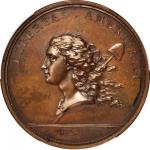
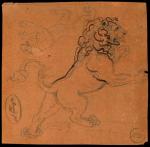

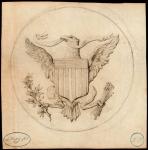


A lovely example of the most famous American historical medal, struck to the specifications and request of Benjamin Franklin in Paris to celebrate the victory of the United States in the American Revolution. The surfaces are lustrous and attractive, mostly medium brown with some variation in shade. Some darker plaque is present inside the stepped rim between 3 oclock and 4 oclock on the obverse, old and harmless, just like the few specks of old detritus in the upper left obverse field. The sharpness and eye appeal are excellent, and only some minor hairlines and light hidden surface dirt are noted. Some areas of thin patina are seen behind the lion on the reverse.No other medal in the canon of American numismatics is invested with so much history and importance as the Libertas Americana medal. It followed the declaration of American independence, whose date is placed in the obverse legend, and the support of France in the American cause. The two greatest American victories, that of Gates at Saratoga and Washington at Yorktown, are referenced with dates in the reverse exergue. The British armies defeated on those dates, Burgoynes force at Saratoga and that of Cornwallis at Yorktown, are incorporated into the reverse allegory as the snakes strangled by Hercules in his crib. In that allegory, France is depicted as Minerva, defending the infant from the lioness, Great Britain, whose tail curls between her hind legs.The obverse design influenced many of the depictions of Liberty that would come from the first United States Mint, directly inspiring the Liberty Cap design found on copper half cents and cents in the 1790s. Dozens, perhaps hundreds, of later American medals and tokens used the design, from privately issued business cards to the United States Mints 1945 Assay Commission medal. Its image was featured on contemporary engravings and textiles, and examples could be found in the 18th century in the collections of Thomas Jefferson, George Washington, John Adams, and more.No founding father is as closely associated with the medal, of course, as Benjamin Franklin. The medal was his brainchild and pet project, and every specimen that survives traces its provenance to him. Perhaps 200 specimens are extant in bronze, the composition Franklin thought most attractive, and a few dozen also survive in silver. As this medal was chiefly distributed to non-numismatists, few survive in superb condition, and most have been heavily handled. This is among the nicest specimens we have been privileged to offer in the last several years.