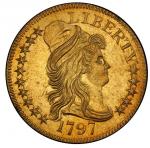
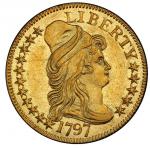

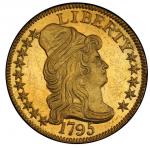

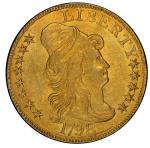
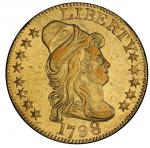
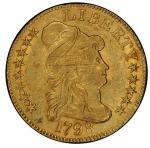
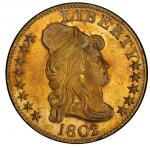
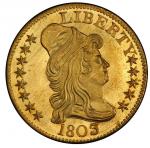
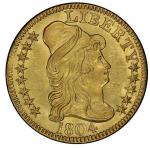
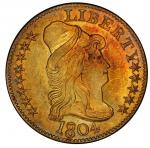
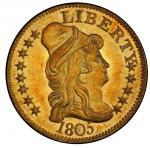

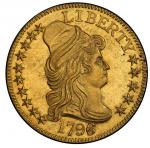
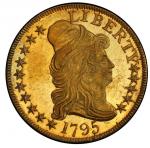
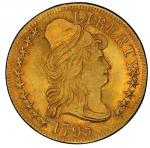
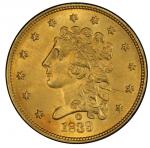
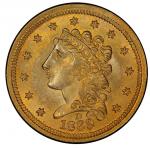
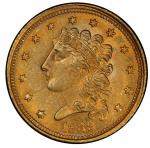
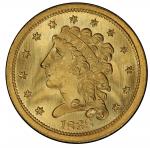
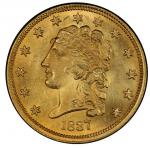


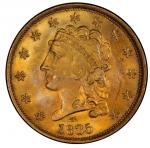
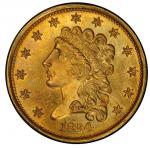

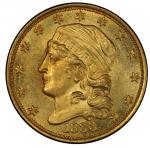

A jack-ass, now in full perfection, will be let to mares at two dollars and a half the single leap, five dollars for the season, or eight dollars to ensure. The tractableness and size of the mules he is the sire of prove him worthy of the attention. -- The North Carolina Journal, Halifax North Carolina, April 24, 1797.Exhibiting superlative aesthetic appeal for the assigned grade, this is the sole Mint State example of this major variety certified by PCGS. Both sides are fully lustrous and show lively, flashy reflectivity in the fields. The surfaces are rich egg-yolk yellow with deeper orange toning seen around the periphery, particularly prominent on the reverse. The fields are somewhat busy with light marks, fine scattered hairlines, and some tiny planchet chips. The largest of the planchet chips, left by some foreign matter on the die, are present behind the eagles head and beneath the wing at right. A thin, short scratch is hidden between BE of LIBERTY, another beneath the wing tip on the right side of the reverse. Adjustment marks are visible outside of the stars at right obverse, extending as high as TY of LIBERTY, present but better obliterated and barely visible around the date. The obverse die crack, extending from the rim down the length of Libertys cap, has caused the center of the obverse die to sink, reducing definition at the extreme center of that side. The opposite area of the reverse likewise shows some softness. A die crack spans the left reverse field from the base of I of UNITED to the juncture of the wing at left and the eagles body; it reappears under the wing at right where the eagles secondary feathers and primary feathers meet. This is Bass-Dannreuther reverse state b, identical to that of the Harry Bass Core Collection coin.This is the finest known example of the 1797 half eagle with 15 stars, representing two different die varieties, both of which are rated Rarity-7 by Bass and Dannreuther. Neither of the retained Harry Bass Core Collection coins are of this quality, and the finest certified by NGC is graded MS-60. In his 1965 series on early half eagles (published separately in 1966), Walter Breen noted "Bell II 568 is claimed as Uncirculated; I have seen one other (the same coin?) in this grade, but most known are in the VF to EF range." Of the 12 examples of the 15 Stars type certified by PCGS, most are now in the EF to AU range, an evolution of the grading standards from the era in which Breen wrote, but this remains the only Mint State coin PCGS has ever certified.J.F. Bell was the pseudonym for a Chicago collector named Jacob Shapiro. Shapiro had made an agreement with Abe Kosoff to buy the entire gold coin collection of F.C.C. Boyd, but eventually ended up instead buying a half share of the collection and bidding heavily on Boyds gold coins in the 1946 "Worlds Greatest Collection" sale. Kosoff lamented years later in a 1967 Coin World column "Later, in 1948, we had a rough period economically ... at this inopportune time, Bell decided to sell." The result was "A Memorable Collection," where this coin did not meet Shapiros reserve price. It reappeared in RARCOAs 1963 J.F. Bell sale, selling to the famed Norfolk, Virginia collector R.L. Miles, Jr., from whose 1968 collection sale it entered the renowned set of half eagles assembled by Ed Milas, a well regarded Chicago numismatist who was a longtime principal of RARCOA.Any Mint State 1797 half eagle is a coin of astounding rarity. PCGS has recognized just two coins at the Mint State level, encompassing all four major Small Eagle varieties combined. That this piece combines such outstanding preservation with strong visual appeal makes it truly special, a prime contender for honors as finest known of the entire date.