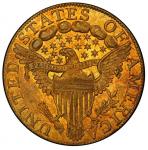
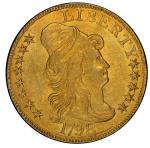
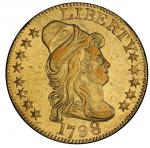
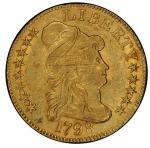
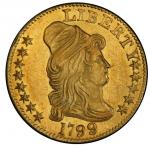
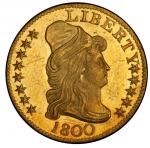
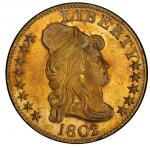
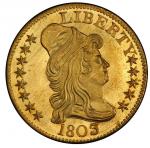
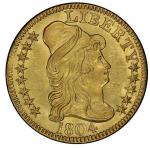
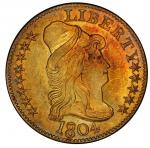
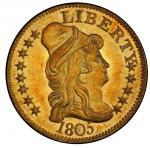

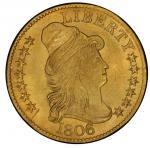
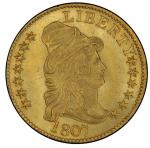


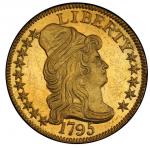

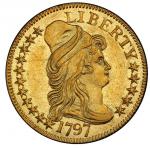
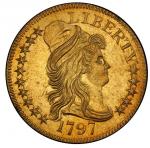
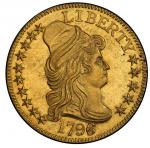
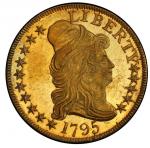
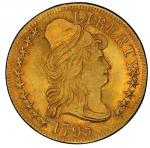
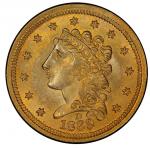
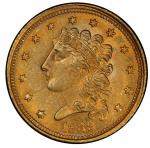
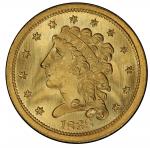
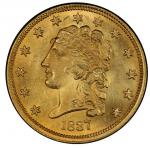


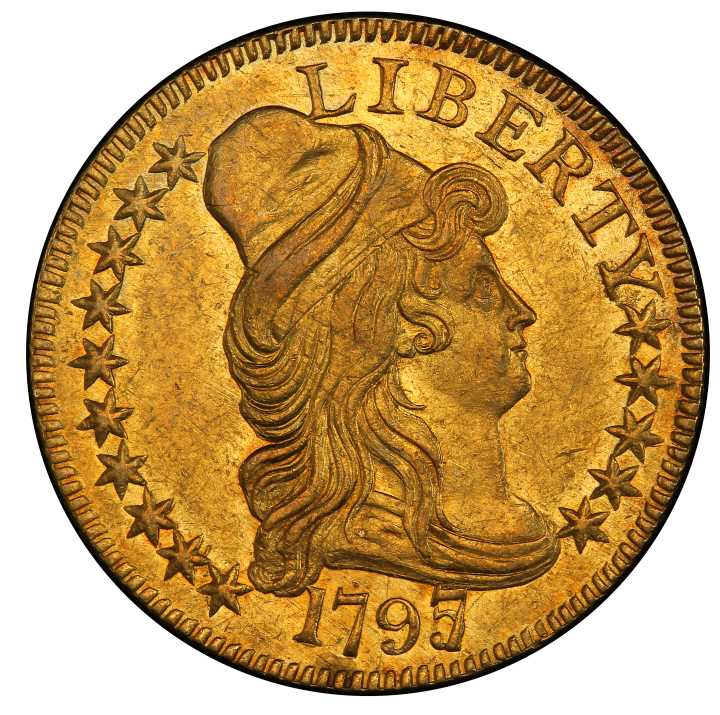
Excessively rare in Unc. -- Don Taxay, 1976.Deep yellow surfaces are enriched with coppery highlights whose depths extend to rose and magenta on the reverse, lending this coin extraordinary originality. Strong luster offers both reflectivity and cartwheel. The strike is excellent, with the centers of both sides showing nearly complete details. Some well-hidden obverse adjustment marks run northwest to southeast, visible at absolute center but nearly entirely obliterated in the fields. One particularly deep stroke is seen running the length of Libertys cap. On the reverse, the adjustment lines are a bit more haphazard, visible at a few odd angles within the shield. Subtle parallel lines are found running just left of vertical if the central reverse is examined closely. Light hairlines are noted, but no heavy marks, just a little nick above the inner tip of star 14. A few small lintmarks are seen on the reverse, including a short curved mark below E of AMERICA, another inside C, and a smaller one left of the lowest arrow head.This specimen was struck from a nearly terminal die state of the reverse die, later than most survivors and quite possibly among the last struck before the die had passed its usefulness. The first crack to appear ran from the rim through the two right serifs of M in AMERICA to the underside of the wing at right. That crack grew to become a semi-circle, crossing the wing and arcing through the upper right serif of M in UNUM, the two left points of star 15, the two right points of star 11, the two right points of star 7, over the cloud to the rim between STATES and OF. Another long crack crosses the right top of the second T in STATES, the left two points of star 3, the right two points of star 13, to the reverse center below the motto ribbon. A further crack, not described by Bass and Dannreuther, links the broad semicircle crack of the right obverse to the center, crossing the right top point of the shield. A final crack is hinted by the Bass-Dannreuther reference, an extension of the crack running from T to star 3 to star 13 that extends below the central reverse, vertical and just left of the shield center, before leaving the tail at the second feather from left and intersecting the rim, making for a true bisector. The next step beyond these cracks likely involved a piece of the die face falling away, perhaps the semicircular piece at right, perhaps the entire left or right side. Suffice it to say this die did not survive long beyond this state, guaranteeing that this variety would always be a rarity.The overdate seen on this variety is one of the boldest in the entire realm of American coinage, easily as plain as the 1942/1-D dime, 1918/7-D nickel, 1918/7-S quarter, and other well-known but comparatively common overdates. The 5 underdigit has not been effaced at all, though the flag of the 7 lines up precisely enough with the flag of the 5 to mask it.Three die varieties of 1797 half eagle are known with the Heraldic Eagle reverse. This is the only one that is not unique. David Akers posited that 12 to 15 specimens were known, while Dannreuther suggested 16 to 20 in all grades. Akers described this coin as "either the first or second finest known example of this extremely rare issue. (Its status as first or second best depends on the quality of the Dunham [B. Max Mehl, 1941] example, long thought finest ...)." The Dunham coin is a cypher; its description of "Uncirculated, with brilliant mint luster; only the faintest touch of cabinet friction" could easily describe a coin that would today qualify as About Uncirculated, and its photograph is useless. This example, the finer of just two Mint State coins ever graded by PCGS, stands alone as finest known.