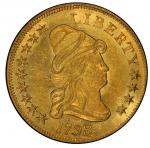
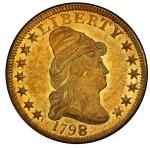
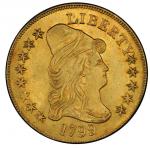
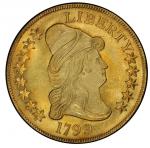
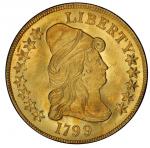

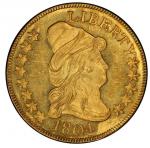
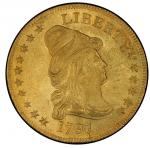
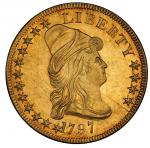
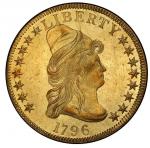
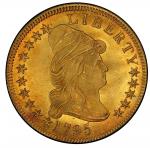



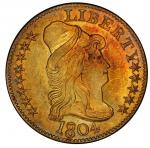
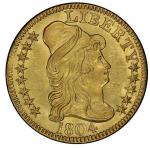
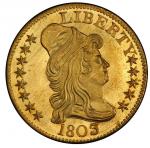
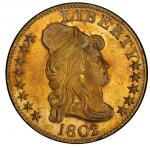
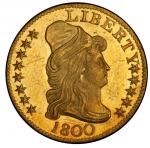

The Clapp Collection was not only nearly complete, it contained coins of extraordinary quality. — David Hall.One of the most extraordinary quality specimens known of this rare eagle issue, the D. Brent Pogue coin is enriched by its provenance to the Clapp and Eliasberg collections. Spectacularly lustrous and deeply reflective, both sides of this coin show stunning revolving cartwheel luster. The very picture of originality, this pieces luxurious deep yellow gold toning serves as a standard against which other early eagles can be compared. Light green highlights are found in proper light, as are subtle splashes of coppery orange. The strike is strong for the issue, one that is found bluntly struck more often than not; while this piece is not completely detailed at center, most finer aspects of the designs are clear. The obverse fields show scattered fine marks and light hairlines, but only a tiny dig between the lips and star 10 and a pinpoint contact mark hugging star 3 require mention. The reverse is immaculate, beautiful, and crisp. Adjustment marks underlie the reverse star cluster in subtle fashion, and a few small lintmarks gather at RI of AMERICA.The overdate is plainly seen under low magnification, and though the central portion of the 7 underdigit was lapped away, its flag and base remain. The obverse is cracked through L of LIBERTY to center, arcing to the back of Libertys hair and reappearing in the lower left field before it disappears harmlessly into the flat. Another crack runs from the rim through the upright of R to the forecurl. Where these two cracks join, another very delicate crack begins, exiting the portrait just below Libertys lips. A clash mark from the shield on reverse appears on Libertys cap and temple, and vertical lapping lines appear lower on her portrait. On the reverse, fine cracks connect the tops of UNITED, but most vestiges of clashing have been polished away, surviving only at the upper tips of the shield.When the agreement was made between Stacks and Louis Eliasberg, the acquisition of the entire Clapp Collection was the largest single numismatic transaction in history. At a price tag of $100,000, thousands of United States and world coins were purchased at once, a giant leap forward in Eliasbergs pursuit to become to first man to complete the entire series of United States coins. Many duplicates were sold off over time, including another 1798/7 9x4 Stars eagle that was sold in Stacks October 1947 H.R. Lee sale, titled with a pseudonym that incorporated the initials of Louis Eliasberg and his mother. The lower grade piece had been acquired only months earlier from B. Max Mehls January 1942 auction. Described as having a Very Fine obverse and an Extremely Fine reverse, its modern whereabouts have not been traced.The eagles of 1798 have long been accorded respect as the rarest date in the early eagle series. Most survivors are heavily handled, and genuinely Uncirculated pieces are highly elusive. The Garrett coin is perhaps the finest known; it remains in the permanent Harry Bass Core Collection. Tied with this piece is the Amon Carter coin, also graded MS-62+ by PCGS. The published mintage figure of 900 pieces is predicated on the assumption that the entire February 17, 1798, delivery of eagles were coins of this variety, perhaps true, though the question is unresolvable. The Dannreuther-Bass reference estimates the mintage at 1,200 to 1,600 coins, of which 80 to 100 survive in all states of preservation. PCGS has graded a specimen of this variety on just 34 occasions. They have never graded one finer than this.