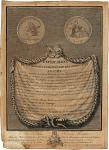
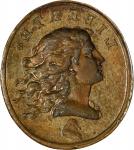


(April 1783) Libertas Americana medal explication (“Explication de la Medaille Frappee par les Americans en 1782”). Laid paper on board, 8 x 6.25 inches (board 9.375 x 12.125 inches). Fine. The single most important paper association item in the realm of American medals, issued to accompany Libertas Americana medals at the time of their release. Printed from copper plate on laid paper, this engraving was "designed and engraved after the medal by Dupre," according to the line under the image, "by J.B. Bradel, citizen of St. Malo." Pierre Jean-Baptiste Bradel was a French engraver who engraved celebrity images of the era (including the 1779 portrait of the legendary Chevalier dEon). The central text summarizes the design of the medal and explains the allegory, while the lower text identifies the Libertas Americana medal as "by his excellency Benjamin Franklin," followed by a list of Franklins titles and honorary memberships. <p><p>In May 1783, Benjamin Franklin ordered 300 copies of this explication, or description, from Paris printer Philippe-Denis Pierres, from whom he commissioned a printing of the collected constitutions of the 13 states contemporaneously. While Franklins letter to Pierres is lost, the confirmation letter from the printer is in the collection of the American Philosophical Society and has been published online by Yale Universitys Franklin Papers project.<p><p>In translation, Pierres May 5, 1783 letter read:<p><p>Sir:<p><p>I have the honor to send you the 300 Copies of the Explanation of the medal, as well as the rest of the sheets which complete the Constitutions.<p><p>I propose, sir, to have the honor of seeing you on Wednesday, in case you are free.<p><p>I am with as much attachment as respect, Sir, Your very humble and very obedient servant.<p><p>Pierres<p><p>I beg your son to accept my very humble civilities.<p><p>The concept of an explication was not a new one, in fact, Dutch, French, and German medals were often issued with them throughout the 18th century. The 1783 Treaty of Paris medal known as Betts-610, struck in Nuremberg, comes with a printed explication on occasion. Perhaps the most notable example of an explication is the one printed for the German struck "1776" (i.e. 1783) Continental dollar, which has exactly one known surviving copy, in the collection of the British Museum.<p><p>This explication is not much more common. The Adams-Bentley book on Comitia Americana medals illustrates Franklins own, in the collection of the American Philosophical Society. We know of no others in private or public hands, but undoubtedly at least a few others survive somewhere. This one turned up in an obscure American auction in March 2015.<p><p>This print is peripherally mounted to a later matting board, with a late 19th century French framers label on the verso. It is complete and untrimmed, though missing the lower left corner, affecting some text. A short split at the center of the top margin matches the short split and loss at the center of the bottom margin. The print is corner-mounted to the board and shows some light staining through its bottom half, most significant near bottom margin. The plate outline is visible around the entire periphery, and the strike is bold and complete.<p><p>An explication is ephemeral, like the box for a toy or the tag for a garment. With medals stored in cabinets in the 1780s, it is only by chance that any were separately filed and saved. This remarkable and rare survivor is as direct from the hands of Franklin as the Libertas Americana medals themselves. It is important, historic, and lends deep context to this and other medals of the era. It would be the centerpiece of an advanced collection.<p>Due to the size and nature of this lot, additional shipping charges apply. Please call 800-458-4646 for more information. From the Cardinal Collection Foundation Collection. Earlier, from John Kraljevich Americana, July 2015.
*拍品信息由各家拍卖公司提供,首席数据中心刊载出于传递更多信息之目的,并不意味着赞同其观点或证实其描述。