


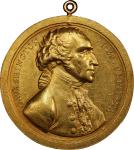
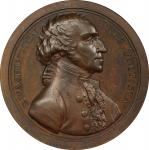


Circa 1816 Halliday Medal. Musante GW-57, Baker-70B. Silver. Thick flan. SP-62 (PCGS). 54.3 mm. 1570.9 grains. An immensely attractive medal, with essentially ideal aesthetic qualities for a large silver piece of this vintage. Generous brilliant silver remains on both sides, including the beautifully rendered portrait of Washington on the obverse, and most of the reverse motif as well. Both areas exhibit a fine satin texture, giving them soft luster. Both the texture and tone set them apart from the fields in a most delightful cameo contrast. The fields are prooflike and deeply reflective, exhibiting soft mottled cabinet toning of pale blue iridescence that clings to the design features. Traces of deeper gray and the occasional wisp of violet are also noted in the recesses. A few scattered nicks and other trivial signs of handling are noted, but these are mostly seen under close study. Otherwise, the appearance is very choice, indeed. <p><p><p>Though the surfaces have seen a bit of light handling, it is nostalgic to consider the hands responsible. From Thomas Halliday to some mid-19th century buyer in London, perhaps? Then to Mr. Fewsmith of Philadelphia, the coin dealer Ebenezer Locke Mason, Sylvester Crosby, John Haseltine, George Fuld, Richard Picker, John J. Ford, Jr., the Stack Family and Michael Hodder, and, of course, Syd Martin. Naturally, those handlers of recent times are not likely to have applied a single mark to this exceptional rarity, but those famous names of old, from a time when numismatic preservation was understood in very different terms, all probably picked this medal up for study or friendly <em>show and tell</em> many times. Every trivial mark is part of that story.<p><p><p>The strike is bold, with exceptional detail throughout. It is clear from study of the reverse that at least four impressions were required to strike up the motifs to their desired relief and crispness. Very tight outlines from earlier impressions may be seen close to the letters in the legend. The planchet was substantial, thicker than seen on nearly all Halliday medals that have passed through our hands. The lone exception was the unusually thick bronze with ornamented rims in our November 2021 sale. The plain rims on this silver example are fully 5 mm thick, a solid millimeter thicker than the bronze in the next lot, which is far more typical.<p><p><p>In 1885, the venerable Washington historian William Spohn Baker introduced the Halliday medal in his catalog as follows: "The most important medal in this group [Military and Civil Career] in an artistic point of view, and as recording two of the most significant acts of Washington, is the Commission Resigned, Presidency Relinquished…" He further commented that "both the obverse and reverse are engraved in the very best manner," and identified it as "one of the valuable pieces of the series," noting that "impressions have become very rare."<p><p><p>Baker misunderstood this piece, believing that it was the original conception that was copied for Joseph Sansoms medal of similar design. The opposite is true, but it would be difficult to argue with Bakers commentaries on the quality of the artistry displayed in this medal, and its significance overall, both in terms of subject matter and rarity.<p><p><p>As alluded to earlier, the first public appearance we are aware of for this piece was Mason & Co.s Fewsmith sale in 1870. It had the briefest of salesmanship in the catalog, as typical of the period: "1797; proof; excessively rare; cost Mr. Fewsmith $50." It sold for $12 to Sylvester Crosby. When Crosbys collection was sold, in 1883, it was described similarly, though noted to be "very thick" and "unique." It realized $45. Fewsmiths $50 purchase price, being much higher than the 1870 realization, suggests that Fewsmith likely acquired it in the late 1850s or early 1860s, when Washington medals were all the rage in the United States, but we have not been able to find his source. <p><p><p>In recent years, fine Halliday medals of all stripes have enjoyed a substantial increase in auction realizations. As far as we are aware, the Gem thick bronze referenced above holds the record for that composition, at $10,800. Perhaps what Baker had to say about the significance of the medal has reached a new sympathetic audience, or maybe the market has simply expanded. This unique silver impression presently holds the record for the issue, at $23,000 from its 2004 sale in Ford, but that figure is likely to very shortly be in second place. From the Sydney F. Martin Collection. Earlier ex Fewsmith Cabinet (at a cost of $50); Ebenezer Locke Mason & Co; Mason & Co.’s sale of the Fewsmith Cabinet, October 1870, lot 1501 (at $12); Sylvester S. Crosby; John Haseltine’s sale of the Sylvester S. Crosby Collection, June 1883, lot 351 (at $45); George Fuld, 1954; Max Schwartz; Richard Picker for John J. Ford, Jr. January 1968; John J. Ford, Jr.; our (Stack’s) sale of the John J. Ford, Jr. Collection, Part II, May 2004, lot 92; Lawrence R. Stack Collection, November 2006.


