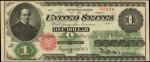
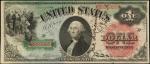
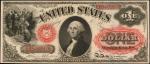
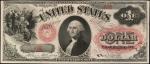
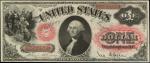
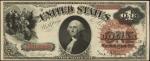
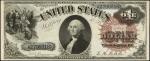
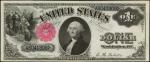
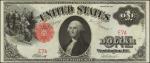
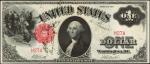
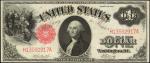
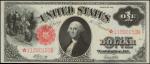
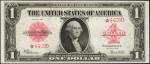

Friedberg 16. 1862 $1 Legal Tender Note. PMG Gem Uncirculated 65 EPQ. This is a vividly printed and fully margined example of this inaugural $1 federal design type. The portrait of Salmon Chase appears at left in excellent detail. This ace, produced by the National Bank Note Company, displays vibrant green protector inks along with bold red overprints including the serial numbers and spiked Treasury Seal. The ornate green printed back is also well detailed and wonderfully centered on the creamy white paper. These notes were printed on four note sheets and featured a rather large plate impression that left very little top or bottom margin. As a result, Gem examples of the type are very difficult for collectors to secure. This is one of just two examples of the catalog number that PMG has graded at this level with only one finer. Legal Tender Notes<br style="box-sizing:border-box;color:#333333;font-family:Avenir, Roboto, Helvetica Neue, Helvetica, Arial, sans-serif;font-size:14px;background-color:#ffffff;" />Legal Tender Notes, as they are generally called, were mostly imprinted with "United States Note" at the border. These were born of necessity for, after December 28, 1861, gold coins disappeared from circulation, and a widely accepted paper-money medium was needed to replace the circulating Demand Notes that were payable in gold. Going into 1862, it was not clear which side would win the Civil War. In England, where the Confederacy sold many bonds denominated in British pounds, there was great sentiment for the South -- the supplier of cotton to that nations textile mills.<br style="box-sizing:border-box;color:#333333;font-family:Avenir, Roboto, Helvetica Neue, Helvetica, Arial, sans-serif;font-size:14px;background-color:#ffffff;" /><br style="box-sizing:border-box;color:#333333;font-family:Avenir, Roboto, Helvetica Neue, Helvetica, Arial, sans-serif;font-size:14px;background-color:#ffffff;" />On January 29, 1862, in a letter to the Committee of Ways and Means, Secretary of the Treasury Salmon P. Chase stated that he had an aversion to issuing paper money not exchangeable in gold or silver coins at face value, but the government supply of such coins was very low. In the meantime, expenses for the war mounted to levels no one had predicted. The solution was to issue Legal Tender Notes that would circulate in commerce, but were exchangeable at face value only for other Legal Tender notes or for the bills of state-chartered banks (which remained in circulation throughout the war).<br style="box-sizing:border-box;color:#333333;font-family:Avenir, Roboto, Helvetica Neue, Helvetica, Arial, sans-serif;font-size:14px;background-color:#ffffff;" /><br style="box-sizing:border-box;color:#333333;font-family:Avenir, Roboto, Helvetica Neue, Helvetica, Arial, sans-serif;font-size:14px;background-color:#ffffff;" />The first Legal Tender Notes are dated March 10, 1862, and were issued in denominations from $5 to $1,000, followed by those dated August 1, 1862, which had values of $1 and $2. Most circulation of Legal Tender Notes consisted of the lower denominations of $1, $2, $5, $10, and $20.<br style="box-sizing:border-box;color:#333333;font-family:Avenir, Roboto, Helvetica Neue, Helvetica, Arial, sans-serif;font-size:14px;background-color:#ffffff;" /><br style="box-sizing:border-box;color:#333333;font-family:Avenir, Roboto, Helvetica Neue, Helvetica, Arial, sans-serif;font-size:14px;background-color:#ffffff;" />Legal Tender bills depreciated from the very beginning. Soon, a double system of pricing arose in the marketplace -- a higher price if paid in Legal Tender bills, a lower one if gold or silver coins were tendered. Indeed, at the outset, there were many merchants who would not accept Legal Tender Notes at all and demanded coins. Not even the Philadelphia Mint would accept Legal Tender Notes in payment at par for the Proof coins it struck for collectors, a situation that endured for many years. To buy such pieces, numismatists had to buy older silver and gold coins from an exchange broker and submit them to the Mint in payment. The height of deprecation was in 1864 when it took $1,000 in Legal Tender Notes to buy $387 face value of gold coins. <em>From Heritages sale of February 1999, lot 6687; Heritages sale of January 2007, lot 14209; Heritages sale of January 2012, lot 17024.</em>
*拍品信息由各家拍卖公司提供,首席数据中心刊载出于传递更多信息之目的,并不意味着赞同其观点或证实其描述。