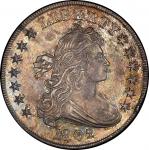
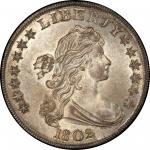
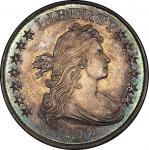
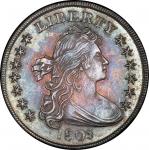

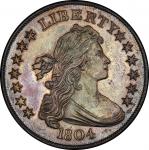
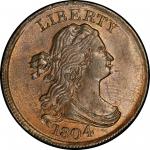
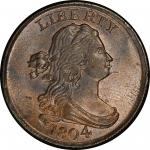
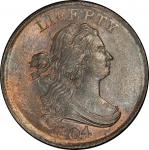
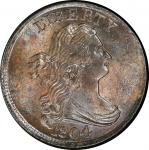
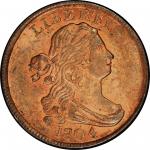
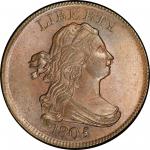
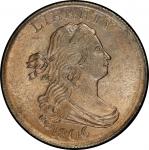
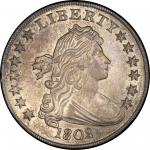
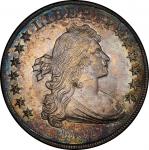
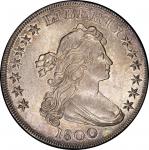
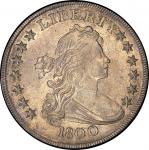
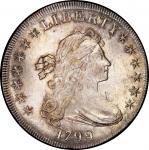
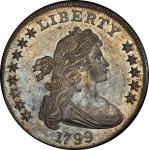
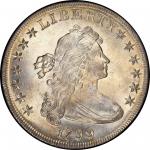

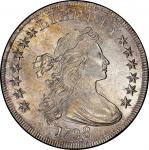
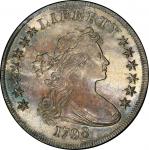
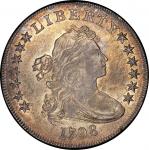


Most 1802 over 1 examples are quite dramatic, plain to the naked eye. - John Haugh, "Overview of Early Dollars Varieties," The United States Early Silver Dollars 1794 to 1803, 1999Lightly reflective and highly lustrous surfaces show a remarkable breadth of autumnal toning, encompassing amber, olive, rose and slate, against a backdrop of deep gray. Peeks of brilliance cling near some obverse design elements. Design elements are well defined overall, though the right obverse stars and some more localized areas show softness. Aside from two parallel marks right of star 2, contact marks tend to be scattered and very minor. The hairlines present are not easily seen. An area of shallow granularity appears as minor discoloration behind Libertys head, far below LI of LIBERTY. Another is seen below reverse star 13, visible behind the eagles neck but mostly struck out on his chest and the upper tip of the shield. The toning lends a look of old-time originality, an appealing contrast to most high grade examples of this date.The die state is advanced on the reverse, following several earlier marriages that saw clashing and lapping. Several areas of die rust or spalling are found under magnification: near Libertys lips, within the shield, below cloud 6, and between reverse stars 1 and 7. All of these are near earlier attempts to polish and repair the die surface, leaving spalling as more likely than oxidation. The spur on the D of UNITED, itself created by lapping, has now been lapped away; the misshapen gap among the tail feathers is larger than on previous marriages. The line below the second S of STATES appears to be a clash mark from the bottom of Libertys bust.The early dollar series includes just two overdates for date collectors to pursue: the 1799/8, which tends to be rather subtle, and the 1802/1, which is not. There are five different 1802/1 die varieties, each using its own unique overdated obverse, a particularly unusual situation considering that there are just two "normal date" 1802 varieties. All five 1802/1 obverses were apparently made in 1801 but remained unused. Large deposits of bullion may have been expected in 1801, but fewer than 55,000 dollars ended up being struck that year, all from just two obverses. Even fewer were produced in 1802, but seven total obverses were employed to coin them. Many 1802-dated coins were likely struck in 1803, when the mintage exceeded those of 1801 or 1802. It is likely more dollars were produced with an 1802 date than 1803, regardless of precisely when they were struck.The overdate on this particular variety is incredibly bold, made more so by the exceptional state of preservation. This example is tied for finest 1802/1 dollar graded by PCGS with the Col. E.H.R. Green - Eric Newman BB-233. Its known provenance begins with the 1987 Buddy Ebsen sale, featuring coins collected by the beloved television and stage actor. While Ebsen was an avid and knowledgeable collector of gold coins from the United States and abroad, he does not appear to have pursued silver coins with similar vigor. Its early provenance has not yet been traced.
*拍品信息由各家拍卖公司提供,首席数据中心刊载出于传递更多信息之目的,并不意味着赞同其观点或证实其描述。