

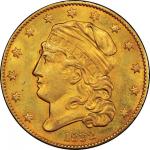
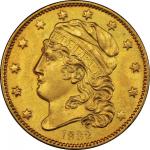

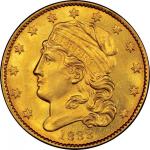
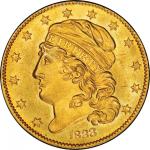
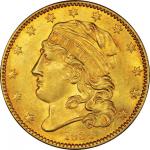
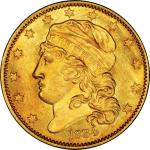
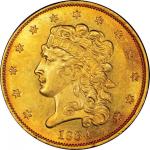
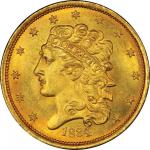
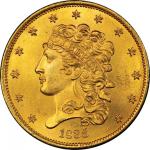
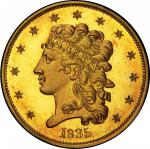
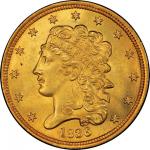
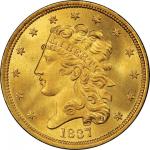
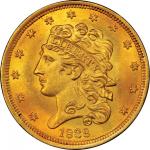
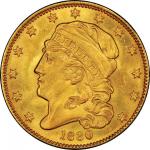
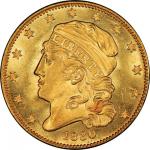
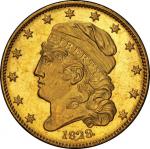
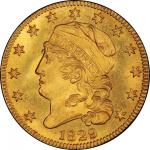

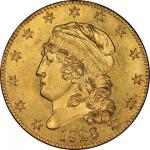
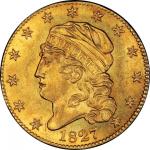

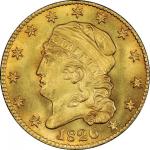
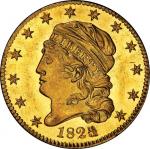

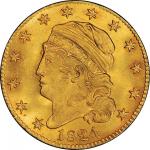


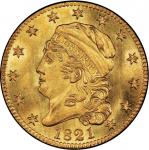

I would say that I think the hobby of coin collecting is interesting and also instructive to any young girl or boy.” — John Story Jenks, “An Account of Some Coins in a Private Collection,” read to the Numismatic and Antiquarian Society of Philadelphia, January 4, 1906</em>A picture of near perfection in radiant deep yellow gold, this is the finest example of this rarity extant, one of “slightly more than a dozen known,” according to the Dannreuther-Bass book. Both sides host abundant reflectivity and clouds of satiny luster, the former alighting the design elements with cameo contrast while the other seems to hover over the brilliant mint-fresh surfaces. The fields are so free of blemishes that nearly all of the very fine parallel lines that formed the planchet’s pre-striking texture remain intact, running diagonally from northwest to southeast on the obverse and northeast to southwest on the reverse. Some areas of coppery toning persist, between stars 3 and 4, to the lower left of the eagle, and ringing the periphery on both sides. The strike is superb, with well realized designs and sharp centers to each star; only the eagle’s wing at left and the curl on Liberty’s cheek show flatness. A short natural planchet striation crosses Liberty’s lowest curl to the field near star 13. Only the faintest of lines are seen scattered over the fields, along with a shallow abrasion on Liberty’s cheekbone and a very light scuff on the high point of Liberty’s neck at her neck curl. The technical quality is superlative. Some light granularity around the eagle’s wing at left comes from the planchet, and a teardrop-shaped struck through (sometimes called a “planchet chip”) is seen between ES of STATES. The dies for this design type were well made, and die cracks tend to be very minor affairs. This obverse’s die state runs counter to that narrative and almost certainly condemned this variety to rarity. The obverse shows surface rust, almost certain to be oxidation rather than spalling. Apparent rust is seen at the outer curvature of the base of Liberty’s cap, above the denticles right of the date, at the juncture of Liberty’s tresses low on her neck, outside of stars 1 and 2, atop the cap to the left of star 9 and light scatterings above the date and elsewhere near the periphery. Two significant die cracks are seen. The smaller one runs from the lower right point of star 11 to a denticle outside of star 12, but the more substantial one crosses the lower tip of star 5 and descends into the center of the die face. A break in the die manifests as a lump between the two lower points of star 5. Harry Bass appears to have been the first to notice that the stars on this obverse make the die unique among the entire Small Diameter type. Bass’s notes on this variety reveal a departure from his usually sober observations: “OBV: Large stars, as 1829 Type I!” Dannreuther hedges, suggesting that “the star punch resembles the large one used for the Large Size type of 1813 through 1829 and may be the same star punch. It seems to be slightly different.” Photographic overlay techniques place a firm answer within grasp. Should the stars prove to be from a different punch, this sole 1831 obverse still stands as distinctive within its type.The provenance of this coin includes some of the most famous numismatists to have ever pursued early American gold coins. This was among the coins Lorin Parmelee acquired in 1873 from the cabinet of George A. Seavey, a collection whose series of United States gold coins was considered complete before 1864, although his 1822 half eagle later proved to be counterfeit. When Seavey’s collection was published by William H. Strobridge in his <em>Descriptive Catalogue</em>, the 1831 half eagle he owned was called “Proof,” while the lower grade duplicate Parmelee sold in the June 1873 Strobridge sale was graded “Fine.” Over the next half century, this coin would be cherished by Lorin Parmelee and Harlan Page Smith, whose collection was sold in 1906, four years after his death. It was acquired in the Chapman brothers’ sale of Smith’s cabinet by a fellow Philadelphian, John Story Jenks, whose cabinet of world coins earned more notoriety than his world-class assemblage of United States and colonial pieces. His collection was so wide-ranging that the well-illustrated 1921 sales catalog of his collection became the standard English language reference for coins of the world for decades. Of the 42 photographic plates issued with the sale, American coins or medals appeared on just nine of them.Rare as a variety and fascinating for its technical aspects, this coin stands out for another reason: it is among the most beautiful and best preserved of all early half eagles. Of all the superlative grade early half eagles in the Pogue Collection, this is the sole MS-67 of the 1829 to 1834 Small Diameter type. This exceptional coin was called a “fine, sharp Proof” in the Parmelee sale of 1890, listed as “Proof” in the John Zug appraisal of the Clapp Collection, and included in Breen’s <em>Encyclopedia of U.S. and Colonial Proof Coins</em> on the basis of its Parmelee appearance. To his credit, Harlan Page Smith crossed out the words “fine, sharp Proof” in his personal copy of the Parmelee sale and neatly penned in “Uncirculated,” a more accurate description. When sold in the Eliasberg sale of 1982, this coin was termed “virtually perfect,” though the tone of that catalog typically erred on the side of being conservative. There is not another 1831 half eagle in private hands that approaches this coin’s level of preservation. The Mint Cabinet coin, the finer of two examples in the National Numismatic Collection, has been graded MS-65, prooflike, by Jeff Garrett and Ron Guth. The only other specimen of the date graded higher than MS-64 by PCGS is the one offered in the following lot.PCGS# 8153. NGC ID: 25RD.


