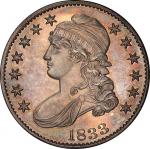
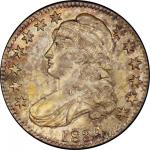
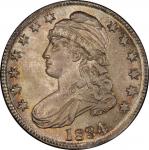
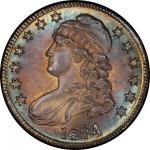
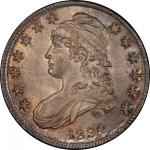
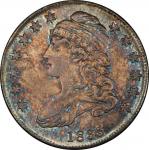
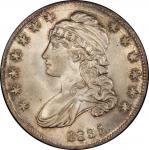
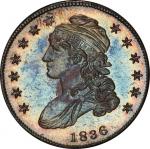
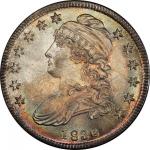
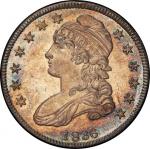
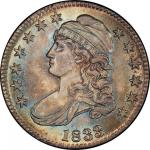
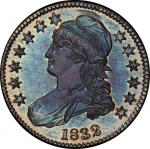
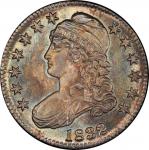
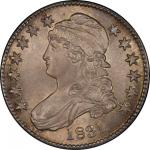
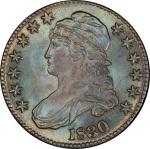
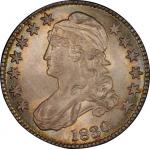
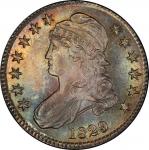

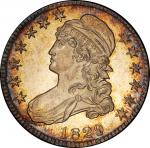


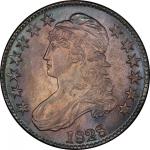
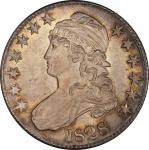
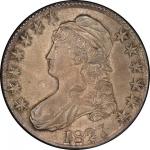
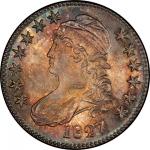

“The late John Pittman was responsible for rekindling the interest in these coins when he displayed his set at the Cincinnati ANA Convention in 1988.” — Russell J. Logan, “Proof Only Die Marriages of our Federal Silver Coinage,” John Reich Journal, April 2003 Crushed Lettered Edge half dollars occupy a unique space in American numismatics. Enigmatic by nature, they’ve been long misunderstood as restrikes and novodels. Walter Breen first wrote about them in the Standard Catalogue of United States Coins while in the employ of Wayte Raymond in the 1950s, calling them “entirely unlike the regular half dollar Proofs of 1832-35 with lettered edge.” Their distinctive nature adds to their attractiveness and mystery, presenting aesthetic appeal that is both different from typical Proofs of the era and immeasurably more impressive. The basic facts of Crushed Lettered Edge half dollars are these: they are struck on normal planchets that were run through the edge mill (also known as a rimming or milling machine) like any other half dollar of the era. Examples bearing three different dates are confirmed to exist, 1833, 1834, and 1835; an 1836-dated piece likely exists but has not been seen since 1954. All share a single reverse die that is also used on 1836 Overton-106. Die emission studies that have analyzed both the die states of that reverse die and the sequence of the edge dies pinpoint the production date of the Crushed Lettered Edge half dollars to early in 1836, before steam power was used to coin half dollars for the first time. The Crushed Lettered Edge halves are all extremely rare, and all were struck as Proofs. Four examples are known of the 1833 variety, five are known of the 1834 variety (Overton-122), and somewhere between three and six are known of the 1835 variety (Overton-111). Though they bear three different dates, the obverse dies were all made at the same time and saw no other use but for Crushed Lettered Edge strikings. Despite similar fabric, each obverse die has distinctly different characteristics. The final fact that unites the Crushed Lettered Edge half dollars is evident by their name: all were struck in a close collar that produced a squared edge at the moment of striking, thereby crushing the previously-impressed edge device. The most important study on these coins was written by the most important modern scholar in the Capped Bust coinage field, the late Russell Logan. His exhaustive article fills much of the December 1990 issue of the John Reich Journal, and even a quarter century later it remains the last word on the subject. Logan presented his data logically and objectively, but he drew few conclusions. Among Logan’s conclusions were these: that the Crushed Lettered Edge half dollars were struck in early 1836, that they were coined on a screw press, and that they “were used to obtain a timely decision to proceed with requisitioning the tooling for the closed reeded collar die.” Expanding on Logan’s theory, the Crushed Lettered Edge half dollars are best interpreted not as restrikes, or Proofs made for collectors, but as technical trials struck to study the interplay of a new close collar with the design elements of the half dollar. Lettered edges disappeared from large cents in 1795 and half cents in 1797. Silver dollars bore lettered edges until the first incarnation of the denomination was discontinued after the 1803 issue. Between the cessation of silver dollar production and 1836, edges remained static: all copper coins had plain edges and all precious metal coins other than half dollars had reeded edges. Edge reeding on gold coins and most silver coins was applied by a collar, imbued at the moment of striking. Half dollars, because of either tradition or technical complications, continued to receive edge lettering from the otherwise antiquated milling machine, adding time and labor to the coining of what had become the Mint’s most numerous production. By February 1836, the first steam press had arrived at the Philadelphia Mint. It was made operational in March, but not used to strike half dollars until November 8 of that year. In the months in between, Mint officials and staff had a lot of questions to answer about what design characteristics were necessary for a successful steam-struck half dollar. Like most technicians, the Mint’s coiners seem to have attempted to answer their questions with an experiment. The Crushed Lettered Edge half dollars are, we believe, the products of that experiment. The new steam presses would be much simpler to operate if the tooling was essentially identical for every denomination, the same in every way aside from which two dies and which collar needed to be installed. Standardizing this tooling meant that half dollar production would have to become consistent with all other silver and gold denominations. The traditional two-step process of edging and striking half dollars would need to be abandoned, and a close collar would need to be substituted in its place. The installation of close collars on other denominations required changes to the obverse and reverse dies themselves, including retaining rims that were lathed into the peripheries of the dies. No denomination then struck at the United States Mint required as much striking force as half dollars. Too much force, or a poorly made die, caused broken dies. Not enough force, or a die made with too much depth of relief, caused poorly struck coins. Solving these problems required an experiment to study how the use of a close collar affected strike detail on various aspects of the coins’ designs. To conduct such a trial, the Mint created special half dollar dies and test collars of half dollar size. They apparently kept examples struck from each of the special trial dies; the Mint Cabinet, now part of the National Numismatic Collection at the Smithsonian Institution, retains one of each of the Crushed Lettered Edge half dollars to this day. Such an experiment would be most successful if easily contrasted data points were created, which could help explain why the Crushed Lettered Edge half dollars were struck with three different dates even if they were all struck at the same time. Russ Logan carefully studied the obverse dies of each of the three known Crushed Lettered Edge varieties. He determined that the width of the date was the same on all three, but other aspects were unique to each obverse. All three obverses had unique denticle counts, each of which matched the denticle counts employed in the year the obverse was dated. The 1833 CLE obverse had 110 denticles, as did typical 1833 half dollars; the 1834 CLE obverse’s 149 denticles matched a typical 1834 half dollar, and the 148 denticles on the 1835 CLE obverse likewise matched the number of denticles from that year. Each of the obverses used a different master die (also called a portrait punch): the 1833 obverse used Master Die 4, the 1834 obverse used Master Die 3, and the 1835 obverse used Master Die 6, as numbered by Logan. While the portraits on the 1833- and 1835-dated CLE obverses matched those found on regular half dollars struck with those dates, the 1834 obverse used an older master die, in use from 1817 through 1832, giving the experimenters more information about which sort of portrait struck up best when employed with a collar. With all of this experimenting, readers may wonder: why use lettered edge planchets? The answer is simple. All half dollar tooling at the Mint, from the blanking press, to the edge mill, to the obverse and reverse dies, was intended to create a single product of identical and fixed dimensions. The steel half dollar die bodies on hand at the Mint were already forged to match the then-current design, made with a die face carefully calibrated to the diameter of a then-current planchet. Those planchets got to their proper diameter only one way: by being cut from stock on a blanking mill and then run through an edge mill. There was no easy way to create a planchet that would match the size of the die bodies on hand but to letter its edge first. The use of three different obverses of the Crushed Lettered Edge half dollars offered the ability to test different sorts of date and star punches (large on the 1833, smaller on the 1834 and 1835), different portraits with different shapes and depth of relief, different denticle counts, and perhaps other differences that are not discernible to our eyes. Russ Logan evaluated the strikes on all three dates of Crushed Lettered Edge half dollars, and found that “the 1833s and the 1835s are weak in the fore curls, while the 1834s are weak in the talons.” The lessons of the Crushed Lettered Edge experiment would have been helpful to Christian Gobrecht as he designed the smaller diameter 1836-1839 Reeded Edge half dollars, first struck on the afternoon of November 8, 1836. Gobrecht was likely intimately involved with the production of the Crushed Lettered Edge coins and almost certainly sunk the dies. A stroke felled William Kneass in the summer of 1835, leaving him “partially incapacitated” in the words of Don Taxay. Gobrecht stepped into this breach and was the principal engraver thereafter. Previous studies of the Crushed Lettered Edge half dollars have not satisfactorily answered one of the most important questions about these special coins: were they struck on the screw press or the new steam press? Logan and others lean toward the screw press, supported by the fact that the reverse die and edge dies employed on the Crushed Lettered Edge half dollars fit into a die emission sequence of coins that were struck when the screw press was actively producing half dollars and the steam press was not. Other facts also support the screw press conclusion. The only steam press at the Mint in 1836 was set up for coins of a smaller diameter, specifically cents and quarters. When Mint officials tried to use it to strike half dollars in November 1836, even half dollars of the smaller size struck from 1836 to 1839, Mint Director Robert Patterson reported that the press “halts and jams under the pressure.” Those issues would have been aggravated with large diameter half dollars. Further, the continuous striking mechanism of the steam press meant that coins could not be carefully struck one at a time; it was more Gatling gun than cannon, designed for speed and efficiency. Even after the steam press was fully streamlined into the Mint’s coining processes, Proof coins continued to be struck on a press run by hand. The Crushed Lettered Edge half dollars themselves do little to inform the viewer what press struck them; the product of identical amounts of downward force upon a set of dies will look the same whether that force is powered by men or steam. The coins do make clear, however, that a raised rim and a retaining collar forces metal into the deepest relief of a die in a way that would be impossible without these advances. The devices of this coin are profoundly well struck, with high relief stars, fine details in Liberty’s curls (though the ones over her ears still do not appear fully struck, as described by Logan), graver lines and delicate contours in Liberty’s cap, sculpted detailing in Liberty’s drapery, full detail in the arrowheads and olive leaves, and bold denticles that are framed by the raised rim. The work of the engraver’s hands is seen on Liberty’s bust, on her nose and eye, and her cap and drapery. Microscopic amounts of die rust remained on the master die, a tool that had been obsolete for a few years by 1836, vestiges of which are seen on Liberty’s bosom, below her drapery clasp, and on the eagle’s beak. A thin graver line arcs atop the denomination to the lowest olive leaves at left. Others are seen stretching into the fields from peripheral lettering or from the denticles, remnants of the lapping process, including a batch left of the date that appear to have removed the flag of the 1. A very thin, delicate die crack connects 183 near their bases and curves along the rim to a denticle next to star 1. Its companion die crack stretches from the base of the final 3 to beneath star 13. The surfaces come to life in direct light, revealing delicate toning of rose, gold, and pale violet distributed evenly over the surfaces. Some apparent streaks of brilliance near the eagle’s beak remain untoned, perhaps by virtue of something that was once in contact with that region. A similarly naked spot is seen left of star 13 below the lowest hair curl. Two short lint marks, one straight and one curled, are seen to the left and right of star 4; a longer lintmark is curled up at the lowest point of star 9. Some light hairlines are seen on both sides, including a short hairline scratch inside of star 4, another above the wing at left to the tip of the beak, and a final one beneath ME of AMERICA. This piece has been beautifully preserved and suffered no significant marks, though a short vertical scrape is well hidden among the azure atop the shield. The visual appeal is spectacular, with deep mirrors and ideally colorful but subtle toning. The edge is smooth, showing an elegant, finished appearance imbued by the collar. The lettered edge remains visible despite being overstruck by the blank collar die, an impact that rendered the letters flat, thin, and “crushed.” A vertical line visible on the edge near 7:00 just left of the left base of 1 in the date accentuates the topographical difference between the face of the edge die that reads FIFTY CENTS OR and the opposite die, engraved HALF A DOLLAR. Though the Crushed Lettered Edge half dollars offer a great deal of insight into the processes of bringing half dollar coining technology out of the 18th century and into the 19th, they are not the only, or even the first, coins to have been struck with crushed edge lettering. In that regard, the Crushed Lettered Edges half dollars are the brethren of Class I 1804 dollars, first made in 1834. Eight Class I 1804 dollars survive, making them twice as numerous as Crushed Lettered Edge 1833 half dollars. Eric P. Newman and Kenneth E. Bressett discussed the crushed lettered edge characteristic in their pioneering 1962 book The Fantastic 1804 Dollar. Coining the term “crushed lettered edge,” they described the phenomenon: “All Class I dollars have most letters on their edges crushed so as to close up in various degrees the indented strokes of the letters. Some letters are unreadable, others completely sealed up. This condition is not found on any other United States coinage except one variety each of proof half dollars dated 1833, 1834, and 1835.” There are only four known examples of the 1833 Crushed Lettered Edge half dollar, also known as 1833 Overton-116. 1. The present specimen. Proof-65 (PCGS). 2. The Norweb-Logan coin, offered in the 1987 Norweb I sale as lot 3015 and the 2002 Logan-Steinberg sale as lot 2707. Proof-64 (NGC). 3. The Mint Cabinet coin at the National Numismatic Collection of the Smithsonian Institution. Graded Proof-63 by Russ Logan. 4. The Cox-James O. Sloss coin. First offered in the 1962 R.E. Cox sale, last offered in the August 1998 Bowers and Merena sale. Circulated. Proof-53 (PCGS). The only auction appearance that cannot be firmly tied to one of the above specimens is lot 798 in the 1915 United States Coin Company sale of the Collection of a Prominent American, offering coins from the cabinets of H.O. Granberg and William H. Woodin. Woodin, a keen collector of both early half dollars and trial or pattern coins, was the likely consignor of the lot. It was described by cataloger and firm principal Wayte Raymond as “1833 Plain edge, uneven date, small letters and 50 C. on reverse. Brilliant proof, lightly tarnished, sharp, beautiful impression. Excessively rare,” making its identification as an 1833 Crushed Lettered Edge piece certain even as its linkage to a particular example is not. The “Prominent American” coin could be either this coin or the Norweb coin. Given the lack of an illustration in the “Prominent American” catalog, an answer will come only upon location of documentation enabling it to be linked to Christian Allenburger or, via intermediaries, Richard Picker, from whom Mrs. Norweb purchased her coin in 1958. It has been nearly 15 years since collectors have had an opportunity to purchase a specimen of this issue. For variety enthusiasts, the 1833 Crushed Lettered Edge half dollar is particularly special, an advanced rarity known only as a Proof and one of the keys for those brave few who attempt to complete a variety collection of Capped Bust half dollars. Specialists intent on completing a set of die varieties by Overton number have not been able to bid on a specimen of 1833 Overton-116 since November 2002, when Russ Logan’s prized specimen, earlier from the Norweb Collection, was offered as part of his lifetime collection of early silver die combinations. Since the first known offering of an 1833 Crushed Lettered Edge half dollar in 1895, this variety has been offered at auction just seven times. One of the survivors, sold in 1962 and 1998, is circulated, leaving just this coin and the Norweb coin as collectible unimpaired examples, with a total of five total auction appearances between them. The first publication of an 1833 Crushed Lettered Edge half dollar was of this precise coin, described in the Richard B. Winsor Collection catalog as “Brilliant proof. Sharp even impression. A superb piece. Inscription on reverse very small like on 1834 small date and differing in this respect from any other 1833 1/2 dollar we have seen. Extremely rare.” Sold on a December evening in Philadelphia, this was among the highlights of Winsor’s much esteemed cabinet even as its exact nature was not yet understood. A century and a quarter later, the 1833 Crushed Lettered Edge half has revealed many of its secrets, yielding a story that makes it among the foremost historical rarities in the D. Brent Pogue Collection. PCGS# 6213.