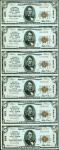

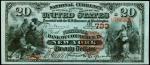
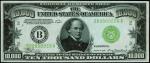
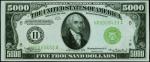
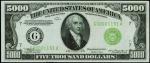

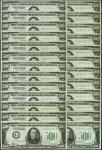
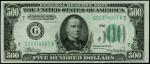

This highly important offering of these small-size $5 National banknotes comprises the sole known uncut sheet on the Chase National Bank of the City of New York. This storied banking institution is still present by name today, It started operations and gained its national charter in 1877, continued operations under the present name until 1955, and acquired several other banks through the early part of the century. The most important acquisition was made in 1930 of the Equitable Trust Company of New York, with the largest stockholder of that institution being John D. Rockefeller. After that transaction the Chase National Bank become the largest bank in the world. The three banknote issuing institutions acquired were charters 891, 1250 and 2598. In 1955 the Chase National Bank merged with the Manhattan Company and adopted the Chase Manhattan Bank name. Today after several other acquisitions mergers and so forth, the institution is under the name JPMorgan Chase Bank, N.A. doing business as Chase. The unique nature of this uncut National Currency sheet is an aberration when compared to other charters with large quantities of known notes. Typically when populations reach into the quadruple digits, sheets are part of the tally. This is not the case here as this is the only known sheet not separated for use in commerce. The notes all have the serial number 400000A with prefixes ranging from A to F as is the norm for the Type I configuration. The sheet shows great originality along with the expected deeply embossed overprints and pristine print quality. Close inspection reveals just a hint of circulation in the form of a broad diagonal fold starting at the lower left center and extending right through the lower two notes of the sheet. The centering is excellent on each impression and there is nice registration of the face and back designs. This is truly a sheet that should never be separated; it is far more desirable as a whole than as parts. As a numismatic footnote we mention that in the late 1920s the Chase National Bank purchased from Farran Zerbe his Money of the World exhibit, which had been widely displayed at various conventions earlier as well as being set up in the lobbies of banks. Chase set up the Money Museum, which operated and was very popular for a number of years, until the modern era of watching the bottom line of profit carefully, at which time it was disposed of, to the American Numismatic Society and to the Smithsonian Institution. , Est. $5000-$10,000