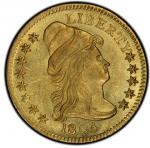
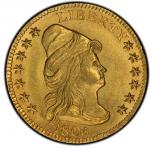
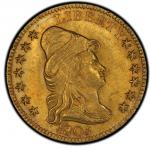
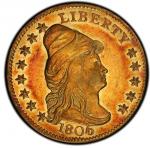
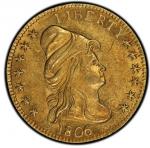
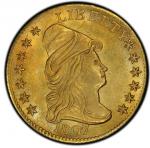
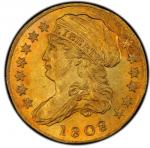
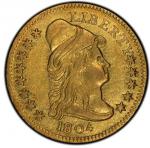
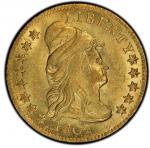
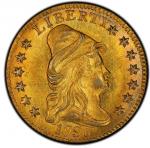
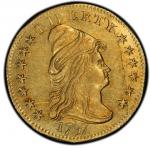
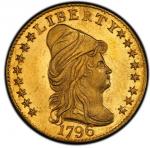
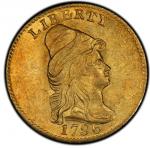
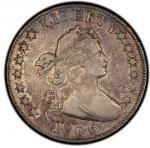
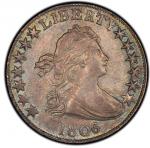
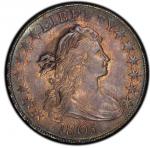

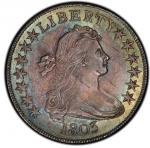
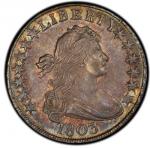

One of the most thrilling we have ever seen. — Q. David Bowers, 2004 An exceptional Mint State piece, a standout specimen with exemplary cartwheel and strong reflectivity in its light yellow gold fields. Choice in appearance, nearly fully struck, and showing no distracting adjustment marks (unlike the retained Harry W. Bass, Jr. core collection piece). The fields show some minor hairlines, including a thin line in the left field to star 4. No significant marks are seen. The definition is excellent, with only obverse stars 2 and 3 lacking centers. Especially bright and satiny in hand, this example rests among the very finest examples surviving from these dies. A very thin die crack runs between the bust truncation and the rim right of the 4 of the date. The popularity of this issue has a lot to do with its date, one of the most famous in numismatics, thanks to the rarity of not only the legendary 1804 dollars, but, to a lesser extent, 1804 cents, dimes, quarters, and eagles as well. The 1804 half cent is the only denomination of this year that can be called common. The reverse die of this variety was also used as the reverse die for some 1804 dimes (the JR-2 variety), offering added interest. The great collector Ed Price was so fascinated by the die varieties of early dimes that he took to collecting early quarter eagle die varieties as well; after all, a coin like this is essentially a dime die marriage, struck in gold. Though the more common of the two 1804 quarter eagle varieties, this remains very rare in Mint State. David Akers recognized just three truly Mint State coins, including this one, specifically mentioning a small number of choice examples exist, including the pieces in the February 1974 Stack s sale and the 1975 American Numismatic Association Sale conducted by Superior. PCGS has only twice assigned a grade higher than MS-62, to this coin and one other, perhaps the February 1974 sale coin. This celebrated coin has been described as the finest known since at least 1975, and has sold only twice in the interim. It has served as the plate coin in two of the most-used references on early gold coins.