
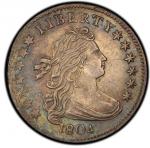

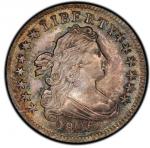
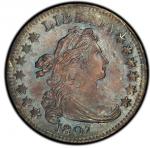
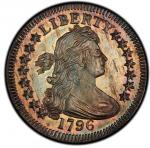


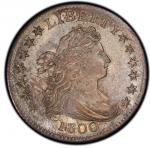
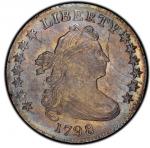
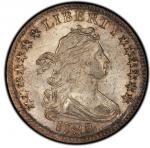
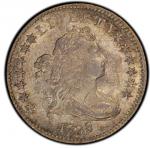

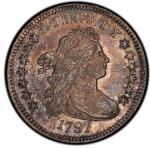
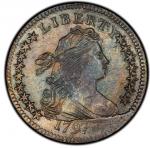
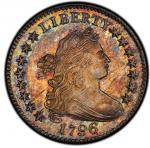
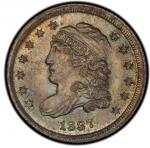
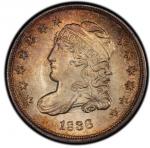
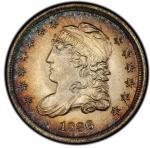

A scarce variety, rare if sharp. Proofs were made from these dies. — Ard W. Browning, 1925The finest known 1822 Proof quarter, and the finest known example of the date in any finish. One of a number of remarkable Proofs in the D. Brent Pogue Collection, showing refinement and intent in the contrast between the deeply frosted figure of Liberty and the mirrored surfaces that surround her. Pale violet dominates the central obverse, while blue and gold form a beautifully toned periphery. The reverse is largely brilliant at center with a subtle overtone of gold, while the border displays bright blue, gold and hints of violet. The aesthetic appeal is that of high art, appearing more beautiful as the eye studies it more and more. The strike is firm, particularly at centers, where the eagles talons show never-seen levels of detail, though several stars lack their centers. The surfaces show no post-striking issues, only the most trivial of occasional lines, and a natural planchet defect right of the shield. The dies, as expected, are perfect.The Rea-Koenings-Haroutunian census lists three Proof examples from these dies, a number that other serious authorities on early Proofs (including David W. Akers and Ron Guth of PCGS CoinFacts) agree upon. Those three, as listed by Rea et al. are: 1) This coin, far and away the finest, from the Eliasberg Collection; 2) the Pittman coin, certified as PCGS Proof-65, acquired from B. Max Mehls 1948 Dr. Christian A. Allenburger sale; 3) a final example, most recently certified by NGC as Proof-63, offered in several different Heritage sales between 2005 and 2009. Before the mid 20th century, there were several other offerings, some of them resolvable to examples listed above, most unplated and thus only able to be tied to a particular coin through speculation. The piece here offered is provably the coin offered in the 1890 Cleneay sale and the 1904 Mills sale; plates exist and they match. Other unplated appearances, including lot 596 in the February 1945 Howard R. Newcomb sale and lot 1650 in the May 1958 Schulman-Kreisberg sale could represent other appearances of specimens 2 or 3, or they could be prooflike coins that would not be considered Proof by modern standards. The 1822 quarters described as Proof in the 1954 Davis-Graves sale and 1956 Lenox Lohr sales appear to be singletons, unconnected to the pedigree chains of any of the three known specimens and not able to be proven as Proofs until examined.In the 1904 Mills sale, the Chapman brothers largely cribbed from their 1890 Cleneay sale description of this coin, calling it Brilliant Proof. Sharp; beautiful impression. Excessively rare. Cleneay Coll. 1333. In 1998 David W. Akers termed specimen 2 on our list, the Pittman coin, one of the most beautiful and important coins in the Pittman collection, and corrected Pittmans assertion that his was the finest known by saying the Eliasberg specimen sold in April 1997 is actually finer than this coin. On that, we all agree. Any Proof coin struck at the United States Mint before the late 1850s is a great rarity, no matter what the grade or overall quality. Proofs from the first Mint, before 1829, represent a victory of will over technology, the very apex of coining in America at the time. All are rare, but not one in ten is as beautiful as this one.


